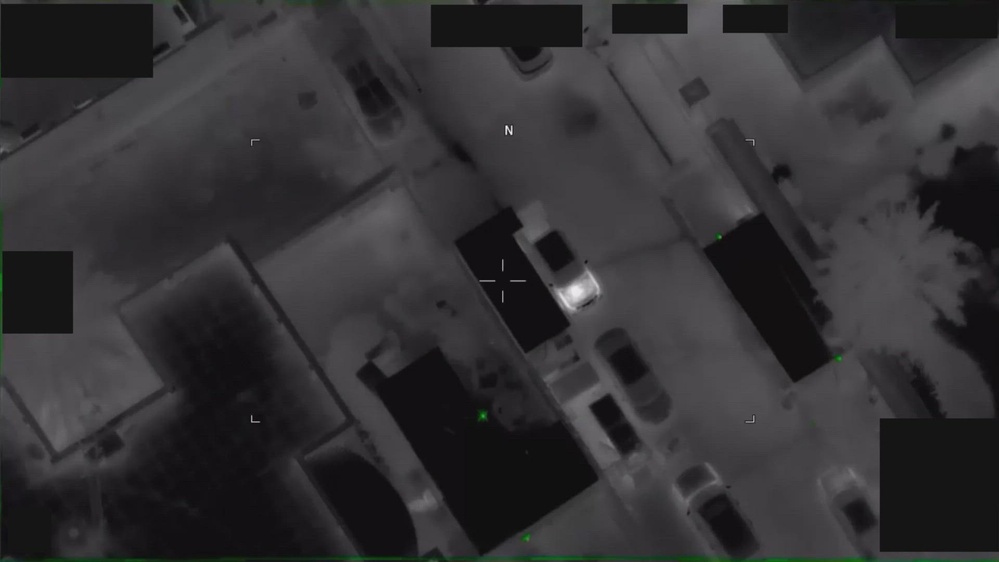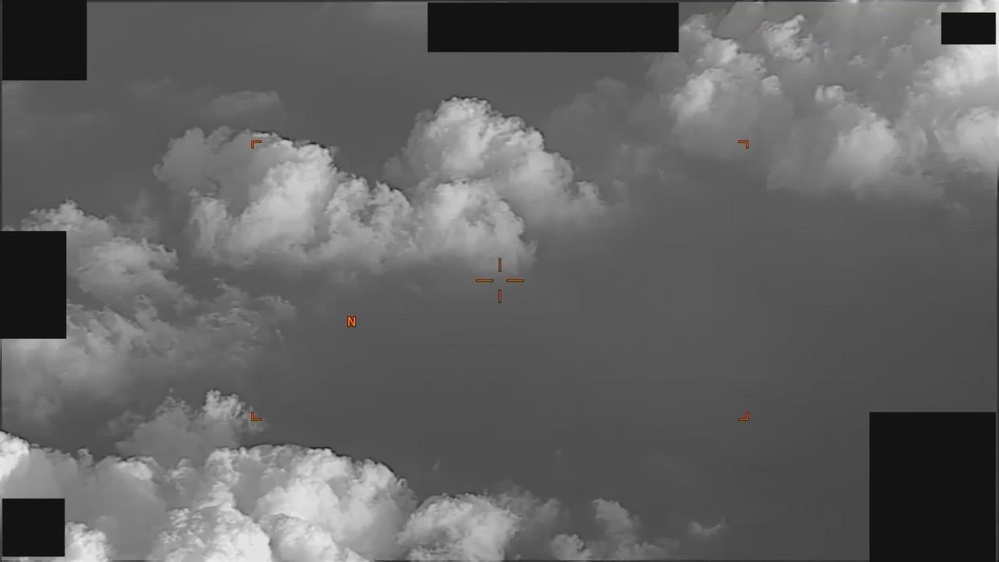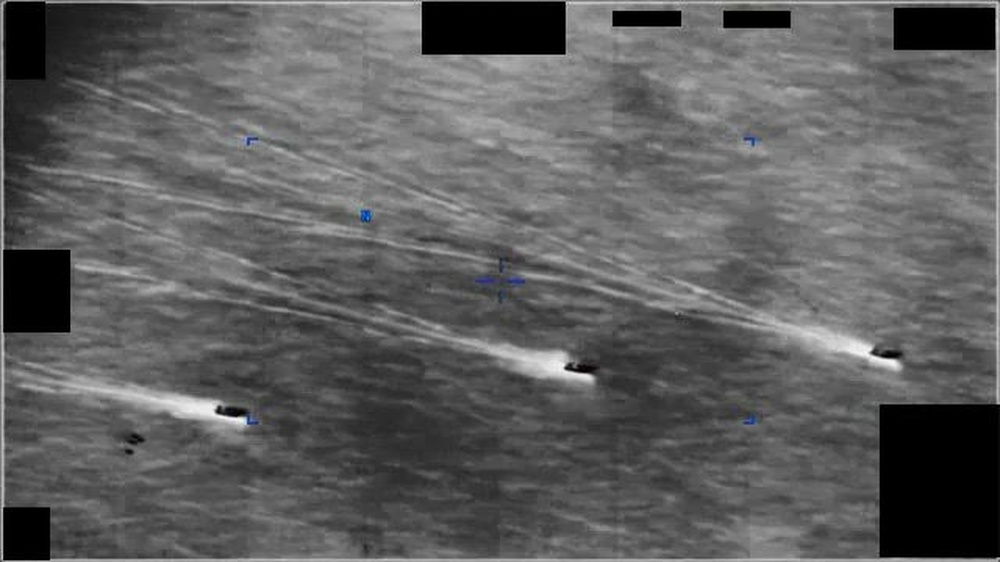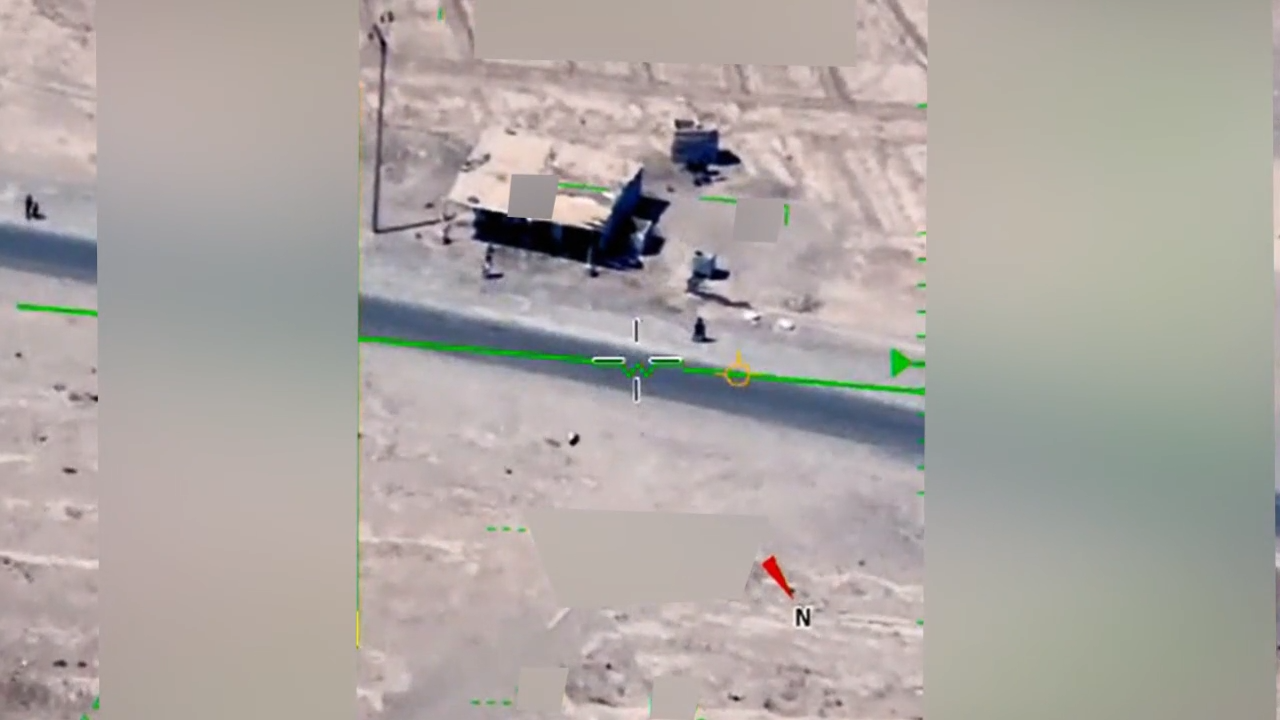
On July 12, 2022, a U.S. MQ-9 Reaper unmanned aerial vehicle conducting an operational mission over an undisclosed location in the Middle East detected and filmed a small unidentified aerial object using its electro optical sensor suite. The resulting footage, approximately 24 seconds in duration, was reviewed by the All-domain Anomaly Resolution Office and later publicly released by the U.S. Department of Defense when AARO director Dr. Sean Kirkpatrick presented it during a Senate Armed Services Committee hearing on April 19, 2023. It became one of the first pieces of military UAP footage to be officially declassified and released in the post AATIP era of government transparency on the subject.
The footage was captured through the MQ-9's Multi Spectral Targeting System, a sensor pod that provides both electro optical and infrared imaging for reconnaissance, surveillance, and targeting operations. The MTS records data continuously during operational missions, giving the footage a credible provenance as authentic military sensor output rather than a recording made by an individual crew member. The video shows the object entering the upper portion of the camera frame and moving across the field of view before exiting. The sensor system's tracking behavior during the clip indicates that the camera was attempting to lock onto and follow the contact.
The object appears as a smooth, polished spherical form reflecting ambient or direct light consistently throughout its time in frame. No wings, control surfaces, engine intakes, exhaust plumes, or any other structural features associated with known aircraft or drone designs are visible on its surface at any point in the footage. Its reflective quality is consistent with a metallic or glass-smooth outer surface and produces the bright, well-defined appearance that has led military personnel and AARO analysts to describe this and similar contacts as metallic orbs or silver spheres in briefing documents.
The object's trajectory during the clip appears broadly linear, though the limited duration of the footage and the motion of the observing platform make it difficult to draw firm conclusions about the contact's actual flight path, acceleration profile, or altitude. The MQ-9 was itself in motion during the recording, which means that the relative motion visible in the footage is a composite of both the object's true motion and the aircraft's own translation, complicating any analysis of the object's true speed or heading derived from the video alone.
The location of the sighting was not officially disclosed beyond the designation "Middle East." Open source analysis of contextual details in the footage and mission documentation available in the public domain led some independent researchers to propose northeastern Syria near Deir ez-Zor as the probable geographic area, though this identification has not been confirmed by any official U.S. government source. The general region of the Middle East in which U.S. MQ-9 operations are routinely conducted in 2022 includes Syria, Iraq, and surrounding airspace where drone operations have been near continuous for more than a decade.
The official investigation was conducted by the All-domain Anomaly Resolution Office, which was established in July 2022 under the Office of the Under Secretary of Defense for Intelligence and Security. AARO was created to centralize and coordinate UAP investigation across all domains, replacing the earlier Unidentified Aerial Phenomena Task Force and incorporating the functions of predecessor programs dating back to the Advanced Aerospace Threat Identification Program. The Middle East Object became one of the cases in AARO's active portfolio from the period shortly after the office's founding and was selected by Kirkpatrick for public presentation as a representative example of the category of metallic sphere contacts that constitute a significant portion of AARO's caseload.
AARO's analysis of the footage concluded that the object's motion in the clip did not demonstrate flight characteristics that could be conclusively categorized as anomalous. Specifically, analysts assessed that the apparent motion of the object relative to the camera could be accounted for by the combination of the MQ-9's own movement, the camera system's field of view and tracking behavior, and a conventionally moving object. This assessment stopped short of identifying the object as any specific conventional type but established that nothing in the visible footage required a non-conventional explanation based on the video evidence alone.
A significant limitation acknowledged by AARO in its public presentation was the absence of corroborating sensor data beyond the single electro optical clip. The MQ-9 platform carries radar and infrared capability in addition to its electro optical systems, but whether radar tracking data was captured for the contact and what it showed was not addressed in the publicly released materials. Without range data from an independent sensor, the object's true size and distance cannot be determined from the video, and without velocity data from radar, its actual speed and heading relative to the ground cannot be established. These gaps leave the core characterization questions for the contact unanswered.
Dr. Kirkpatrick's presentation of the footage to the Senate Armed Services Committee was accompanied by broader briefing data indicating that AARO had by that point compiled a case database of more than 650 UAP reports, with metallic sphere or orb shaped objects representing a disproportionately large fraction of the contacts. This context positioned the Middle East Object not as an isolated oddity but as a representative specimen of a recurring and geographically distributed contact category that AARO was encountering across multiple theaters of U.S. military operations simultaneously.
The case's public release as part of a congressional briefing rather than through a scientific publication or formal investigation report means that the methodology and full scope of AARO's analysis have not been publicly documented in a form that allows independent scholarly evaluation. The clip itself is the totality of the publicly available evidence, and the analytical conclusions presented by Kirkpatrick were offered as institutional assessments rather than peer reviewed findings. This format is consistent with how the UAP Task Force and AARO have communicated findings to date but limits the ability of outside researchers to assess the rigor and completeness of the official analysis.
AARO's official conclusion is that the Middle East Object remains unidentified but is not assessed as exhibiting anomalous behavior based on the available evidence. This dual designation, unidentified but not anomalous, reflects the agency's analytical posture across many of its single sensor cases: the object cannot be identified from the footage alone, but the footage also does not contain visible evidence of performance that exceeds the capabilities of known aerial platforms. The absence of positive identification and the absence of observed anomalous performance are treated as separate questions rather than conflated into a single determination.
The case's significance in the AARO evidence portfolio is primarily typological rather than uniquely dramatic. Kirkpatrick explicitly presented it as one representative example of a broad contact category rather than as a singular or especially compelling event. This framing is itself analytically meaningful: if metallic sphere contacts are sufficiently common to constitute a recognized and recurring category across multiple theater of operations, the collective significance of that pattern is likely greater than any individual clip within it. The Middle East Object footage is a single data point in what AARO has characterized as a systematic and widespread phenomenon.
The designation of the object as unidentified while simultaneously not anomalous raises a legitimate analytical question about what criteria AARO applies to each determination. An object can be both genuinely anomalous in its physical properties and not visibly performing anomalously within the duration of a 24 second clip. The absence of observed anomalous behavior in a brief sensor recording cannot constitute strong evidence that the object is not anomalous in any meaningful sense, only that anomalous behavior was not observed during that specific window of footage. Whether AARO's assessments appropriately account for this distinction has been a point of criticism from researchers who believe the agency's framing systematically minimizes the significance of unresolved cases.
The broader pattern of metallic sphere contacts documented across AARO's case database, of which the Middle East Object is one, constitutes one of the most consequential unresolved questions in the current UAP investigation landscape. The frequency, geographic distribution, and operational context of these contacts suggest an aerial phenomenon that is present in active military operating environments on a recurrent basis. Whether these objects represent adversarial reconnaissance technology, a natural or atmospheric phenomenon not previously characterized, or something else entirely has direct implications for military operational security, airspace management, and the safety of crewed aircraft operating in the same environments where these contacts are routinely detected.
- Q.01What does the MQ-9's radar data show for the contact? The MQ-9 platform carries the Lynx multi-mode radar system capable of tracking airborne contacts in addition to ground imaging. Whether this radar system was operating in an airborne tracking mode during the encounter and whether it produced a return for the object at the time it was visible in the electro optical footage has not been established in any publicly available AARO document. Radar data from the same sensor platform would provide independent range, velocity, and altitude information for the contact that the video alone cannot supply.
- Q.02What does the MQ-9's infrared channel show for the object? The Multi Spectral Targeting System includes an infrared imaging channel in addition to the electro optical channel. Infrared data would reveal whether the object has a thermal signature consistent with a propulsion system, whether it is at ambient temperature consistent with a balloon or inert object, or whether its thermal characteristics are anomalous. Whether infrared data was captured during the encounter and what it shows has not been addressed in any publicly available description of the AARO analysis.
- Q.03Was the object detected by any other platform or ground based radar facility operating in the area at the time? MQ-9 operations in the Middle East theater take place within a comprehensive sensor architecture that includes ground based radar, other airborne assets, and in some areas satellite coverage. Whether any other sensor platform in the operational environment established independent contact with the object at the time of the MQ-9 encounter, and what those contacts would show about the object's origin, track history, and departure, has not been addressed in publicly available AARO materials.
- Q.04How many similar metallic sphere contacts has AARO documented in the Middle East theater specifically, and is there a geographic or temporal clustering pattern? Kirkpatrick stated that metallic spheres represent a significant proportion of AARO's overall case database. Whether this category of contact is distributed uniformly across all theaters where U.S. military sensors operate or is concentrated in specific geographic regions and operational contexts, and what the temporal distribution of contacts looks like, could substantially clarify whether the phenomenon has a specific source or origin area that correlates with known infrastructure, adversarial activity, or geographic features.
- Q.05What is the complete footage duration and does the extended version show any behavior not present in the publicly released clip? The publicly released version is approximately 24 seconds. Whether the MTS recording extends before and after the released segment, what the object's behavior was during any unreleased portion, and whether any such extended footage was reviewed by AARO analysts but withheld from the public release has not been established. The released clip begins with the object already in frame and ends before any confirmed departure, leaving the beginning and end of the encounter undocumented in the public record.
- Q.06What does the pattern of metallic sphere contacts across AARO's full case database reveal about the nature and origin of this phenomenon? The Middle East Object footage is one entry in a case archive that by April 2023 contained over 650 reports, with metallic spheres representing a recognized and recurring subset. Whether AARO has conducted systematic pattern analysis across all sphere contacts to identify common altitude ranges, speeds, operating environments, times of day, and geographic concentrations has not been publicly described in detail. Such a pattern analysis, if conducted rigorously and shared with the scientific community, would constitute one of the most significant contributions AARO could make to the public understanding of what is arguably the most commonly reported and consistently unresolved contact category in the contemporary military UAP record.