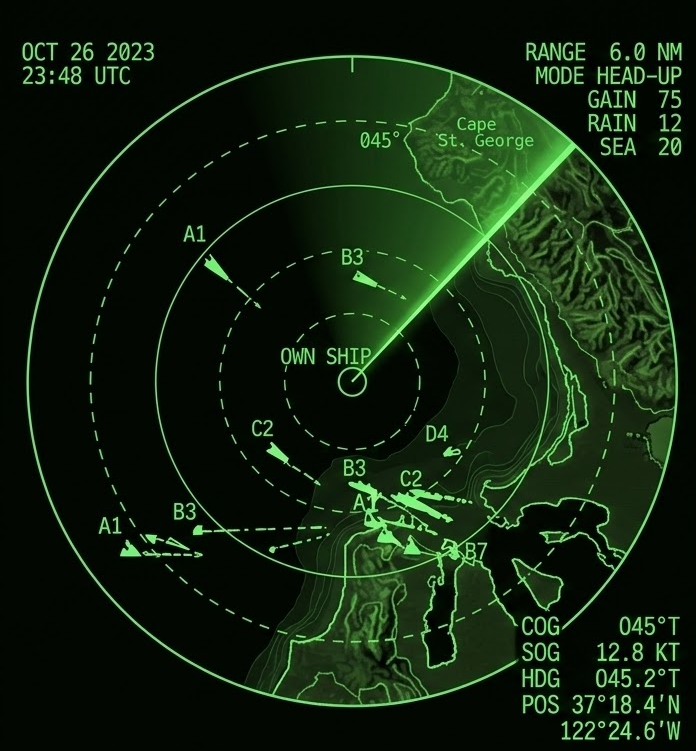
In the early morning hours of July 20, 1952, radar operators at Washington National Airport detected seven unidentified targets on their radar screens moving over the restricted airspace of Washington D.C. at speeds ranging from very slow to extreme. The contacts appeared without explanation and moved erratically, with some accelerating from approximately 100 miles per hour to speeds estimated at 7,200 miles per hour in seconds. Air Route Traffic Control Center radar supervisor Harry Barnes coordinated with tower radar operator Howard Cocklin, both of whom independently confirmed the contacts on separate radar systems simultaneously. The radar returns were solid and consistent, behaving like aircraft rather than weather anomalies.
The contacts traversed some of the most sensitive restricted airspace in the United States, including the corridor directly over the Capitol building and the White House. Tower radar operator Cocklin confirmed that at least one of the radar contacts corresponded to a visible light in the sky at the same bearing, providing the first visual corroboration of the radar data that night. Other controllers on duty independently observed the lights described as moving at speeds far exceeding anything they could identify as conventional aircraft on final approach or departure routes.
Among those who rushed to Washington National Airport on the night of July 26 was Albert M. Chop — the Air Force's civilian press spokesman for Project Blue Book, who had been transferred from Wright-Patterson AFB to the Pentagon's press section earlier that year specifically to handle the surge of media inquiries about UFOs. Chop arrived to find a room already crowded with reporters demanding access to the radar scopes. He permitted them inside the radar room — a detail later altered in the 1956 documentary film UFO, which depicted him refusing their entry. Also present was Major Dewey Fournet, Project Blue Book's liaison at the Pentagon. Chop would watch the returns for nearly fifteen minutes.
I looked at the radarscope and there were about 10 or 14 unknowns. They looked just like aircraft. They had the same kind of strong signal, but we couldn't contact them. We just looked at each other as if to say, "what should we do?" Then, we just watched them. We were kind of helpless.
— Albert M. Chop, Air Force civilian press spokesman, Project Blue Book · recalled fifty years laterWhen F-94 interceptors were scrambled and Lieutenant William Patterson found himself surrounded by the lights, he radioed Washington National's control tower asking what he should do. According to Chop, who was standing in the radar room at that moment, the answer from the tower was silence.
I see them now and they're all around me. What should I do?
— Lt. William Patterson, F-94 pilot, to Washington National control tower · July 26, 1952Nobody answered, because we didn't know what to tell him.
— Albert M. Chop, describing the control room response to Patterson's call · HowStuffWorks / NICAPPatterson reported that the four lights then pulled away from his aircraft and disappeared. Chop later described the atmosphere in the radar room that night as "electric" — with a dozen news media representatives present alongside government personnel and airport operators, all watching the unknown returns traverse the scopes. Chop's personal witness to the events of July 26 would mark a turning point in his own views. He subsequently stated publicly and on record that he believed UFOs were a real, physical phenomenon of unknown origin — a conclusion reached, he said, not from speculation but from what he personally observed in that radar room.
Andrews Air Force Base, located approximately ten miles east of Washington National, had its own radar systems tracking the area. Andrews radar operators confirmed independent returns corresponding to the Washington National contacts on their own equipment, providing the critical second independent radar system confirmation that eliminated the possibility of a single radar malfunction or local atmospheric propagation anomaly. An F-94 interceptor scrambled from Newcastle Air Force Base in Delaware arrived over Washington but the contacts faded from radar before the pilot could close to visual range. When the interceptor departed the area, the radar returns reappeared.
The incident repeated itself the following weekend. On the nights of July 26 and 27, 1952, an even larger and more sustained wave of unidentified radar contacts appeared over Washington. This second event involved more contacts, longer duration observations, and additional visual corroboration from both airborne and ground observers. Two F-94 interceptors were scrambled and the pilots reported seeing lights that they could not close with before the lights disappeared and reappeared elsewhere. One pilot reported being surrounded by lights that moved away when he accelerated toward them. The events of the 26th and 27th were among the most dramatic in the history of American UAP incidents and produced the largest peacetime Pentagon press conference since World War II.
At that press conference on July 29, 1952, Air Force General John Samford addressed a room packed with journalists and stated that the Air Force had no explanation for the Washington radar contacts. He acknowledged that a small percentage of UAP reports came from reliable observers and involved objects described as maneuvering in ways that exceeded any known aircraft performance. His statement, delivered by one of the most senior Air Force officers in the country, represented one of the most candid official acknowledgments of genuine UAP uncertainty ever made at a government press conference in the Cold War era.
Project Blue Book, under the direction of Captain Edward Ruppelt, investigated the Washington incidents as its highest priority cases of 1952. Ruppelt interviewed the radar operators, the interceptor pilots, and the tower personnel who had visual observations. He assessed the witnesses as thoroughly credible professional aviation personnel and the radar evidence as among the strongest his program had encountered. The simultaneity of returns on multiple independent radar systems at Washington National and Andrews AFB was particularly compelling, eliminating single point equipment failure as an explanation.
The official explanation that Blue Book ultimately adopted drew on atmospheric physics rather than equipment malfunction. Radar meteorologist Donald Menzel and other scientific consultants proposed that a temperature inversion layer present over Washington on both nights of the incidents could produce anomalous radar propagation effects, causing ground clutter or distant ground objects to appear as moving aerial targets on the radar screens. Temperature inversions, in which a layer of warm air sits above a layer of cool air near the surface, can under certain conditions cause radar beams to bend downward and reflect energy from ground objects back to the receiver, producing spurious targets that appear to move as the atmospheric layer shifts.
The temperature inversion explanation was immediately challenged by the radar operators who had experienced the contacts directly. Supervisor Harry Barnes stated publicly and repeatedly that he was thoroughly familiar with temperature inversion effects on radar from years of operational experience and that the July 1952 contacts did not behave like inversion returns. He described them as solid, consistent, and behaving like real aircraft, with none of the diffuse or intermittent character typical of propagation anomalies. His professional assessment, delivered with the specificity of an expert who had spent years interpreting radar data in the Washington area, was never rebutted by any official with equivalent radar operational experience.
The Robertson Panel, convened by the CIA in January 1953 partly as a response to the Washington incidents and the public attention they had generated, reviewed the radar data from the July events. The panel's scientists, applying the temperature inversion explanation, concluded that the Washington incidents had a satisfactory conventional explanation and did not represent genuine anomalous aerial phenomena. This conclusion was heavily influenced by the desire to reduce public UAP interest for national security reasons rather than being driven purely by the scientific evidence, as documented in the panel's own internal memoranda declassified decades later.
Albert Chop's role in the aftermath was significant beyond his eyewitness presence. Transferred to the Pentagon press section by Air Force Public Relations Chief Colonel DeWitt Searles at the direct request of General Samford specifically to manage the media fallout from the 1952 UFO wave, Chop had the unusual distinction of being both the Air Force's official civilian spokesman on UFO matters and a personal witness to the events he was tasked with explaining publicly. He later wrote letters to NICAP's Major Donald Keyhoe confirming the release of official UFO case files by the Air Force. His 1952 experiences became the subject of the 1956 United Artists documentary film UFO: The True Story of Flying Saucers, portrayed by actor Tom Towers. At the film's conclusion, Chop — appearing as himself — states on camera his personal belief that UFOs are a real phenomenon of unknown origin. He went on to become Deputy Public Affairs Officer at NASA's Manned Spacecraft Center in Houston during the Gemini program.
The CIA's role in the aftermath of the Washington incidents extended beyond the Robertson Panel. Declassified documents show that the CIA monitored public and press coverage of the incidents closely and was concerned about the potential for Soviet exploitation of American public anxiety about unidentified objects in restricted airspace. This national security context shaped how the official investigation was conducted and communicated and contributed to the pressure on Project Blue Book to produce a conventional explanation regardless of whether the evidence fully supported one.
Project Blue Book's official conclusion was that the Washington radar contacts were caused by temperature inversions producing anomalous radar propagation returns. This explanation was accepted by the Air Force and became the official account of the incidents. It satisfied the institutional requirement for a conventional explanation but was explicitly rejected by the most qualified observer of the radar evidence, the operators who had watched the returns directly and who had the professional experience to assess them against their knowledge of known radar anomaly signatures.
The Washington incidents occupy a unique position in UAP history as the only case in which truly anomalous aerial contacts were observed over the restricted airspace of the national capital by multiple independent radar systems simultaneously, with visual corroboration from trained aviation personnel, while interceptor aircraft scrambled to investigate found themselves apparently being evaded by the contacts. The combination of these elements in the most symbolically and operationally sensitive airspace in the United States makes this case categorically different from most UAP incidents in terms of its national security implications.
General Samford's July 29 press conference remains one of the most significant official public acknowledgments of genuine UAP uncertainty in American history. His statement that reliable observers were reporting objects that exceeded known performance envelopes was delivered at the highest level of official credibility available to the Air Force and was never retracted or formally qualified. It stands in stark contrast to the dismissive posture that Blue Book adopted for most of its operational history and reflects the genuine institutional uncertainty that the Washington incidents produced at the most senior levels of the Air Force establishment.
The Washington case was directly causally responsible for the convening of the Robertson Panel, which in turn shaped Air Force and CIA UAP policy for the following sixteen years. The policy of systematic debunking and public education that followed the Robertson Panel was a direct institutional response to the public alarm generated by the Washington incidents. Understanding the Washington case is therefore essential to understanding not just a specific UAP event but the entire subsequent trajectory of American government UAP policy through the closure of Project Blue Book in 1969.
- Q.01Can the temperature inversion explanation account for the specific behavior of the radar returns as described by the operators? Supervisor Barnes explicitly stated that inversion returns do not behave like what he observed, citing their solidity and consistency as unlike known propagation anomaly signatures. A definitive atmospheric physics analysis of whether the documented meteorological conditions on July 19 to 20 and July 26 to 27, 1952 could produce returns of the character, speed, and behavior described by the Washington National operators has never been publicly produced.
- Q.02What did the F-94 pilots observe and why could they not close with the visual contacts they reported? The interceptor pilots reported lights that moved away when they accelerated toward them. Whether this behavior represents genuine reactive evasion by the objects or an optical illusion created by the pilots' own speed and the lights' actual fixed position has never been formally analyzed in the investigation record.
- Q.03Were the Andrews AFB independent radar returns subjected to the same temperature inversion analysis as the Washington National returns? The simultaneous confirmation at an independent facility approximately ten miles away is the most powerful element of the multi radar corroboration. Whether the meteorological conditions at Andrews on the relevant nights were assessed independently and found equally consistent with the inversion hypothesis has not been established in publicly available accounts of the official investigation.
- Q.04What do the original radar recording tapes from both nights show, and do they still exist in any archive? In 1952, some radar facilities used recording equipment to preserve track data. Whether any recorded radar data from Washington National or Andrews AFB from the July 1952 events was preserved and archived, and whether it is accessible to modern researchers applying current radar analysis methods, is an open question that could substantially enrich the evidentiary assessment of the case.
- Q.05What was the classified assessment that the CIA and Air Force developed internally following the Robertson Panel, and how did it differ from the public temperature inversion account? The Robertson Panel's recommendation to pursue public debunking was adopted as policy, but the internal CIA and Air Force assessments of the Washington incidents may have been more candid. Whether any classified assessments that reached different conclusions from the official public account exist in declassified archives has not been fully established through available FOIA research.
- Q.06What does the Washington incident reveal about the gap between official explanations and internal government assessments of major UAP events? The Washington 1952 incidents produced the most dramatic public official acknowledgment of genuine UAP uncertainty in the early Cold War era, followed within months by a classified policy of systematic debunking. This sequence illustrates a pattern that has recurred across UAP history: genuine internal uncertainty being replaced in the public record by conventional explanations driven by institutional and national security considerations rather than evidential conclusions. Understanding how this pattern operated in 1952 is directly relevant to evaluating the credibility of official UAP accounts in every subsequent era, including the current AARO period.