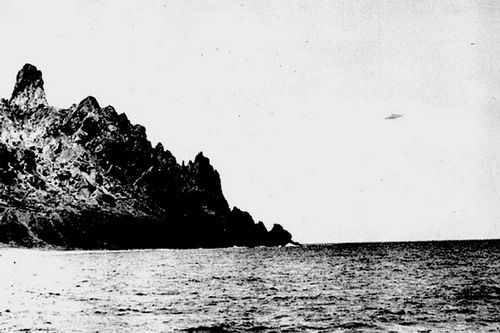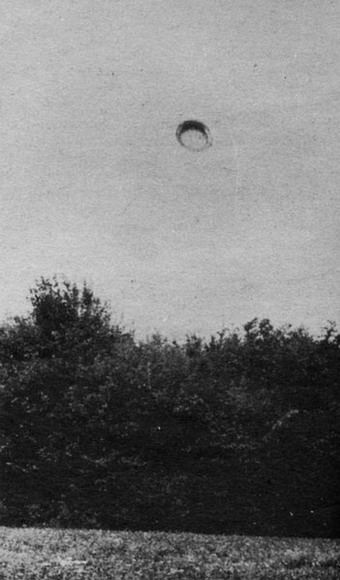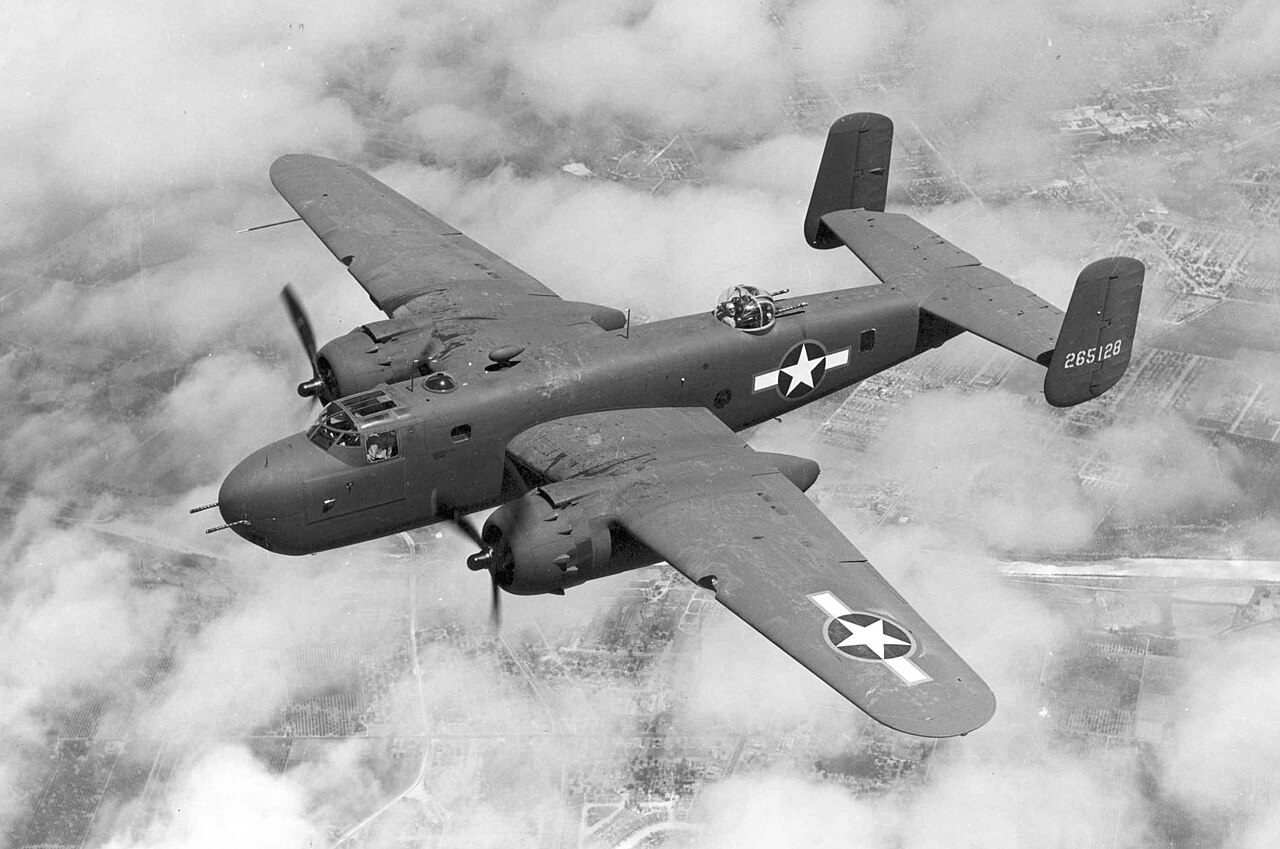
On a clear afternoon in July 1955, a U.S. Air Force North American B-25 Mitchell bomber departed Miami, Florida, on a routine transit flight north toward Greenville, Mississippi. At the controls was Major William T. Coleman — a decorated World War II combat pilot, then serving as an active-duty Air Force officer. Aboard with him were four additional personnel: a co-pilot, a flight engineer, a Lockheed test engineer, and a General Motors jet engine technician. The aircraft was at approximately 10,000 feet over southern Alabama, somewhere between 2:00 and 2:30 p.m. local time, when the encounter began.
Coleman's co-pilot first noticed an anomaly and drew his attention to the 2 o'clock high position. Coleman initially dismissed it — what he later described as a "craze" or glint in the windshield, possibly a sun reflection. After several more minutes he looked again and realized the object was real, structured, and closing in altitude. It was a sharply defined disc, highly reflective at altitude, descending toward the ground from an estimated 20,000–25,000 feet. It was approximately seven miles ahead and to the right of the aircraft, moving at a speed that prompted Coleman to make an immediate decision to intercept.
The co-pilot told me to look out at 2 o'clock high, so I turned around and pulled my seat back up and said it could be a little bright spot from sun reflection.
— Col. William T. Coleman, interview with The Huffington PostColeman pushed the B-25 to maximum continuous power — approximately 300 miles per hour — and descended in pursuit as the object plunged toward the Alabama farmland below. What followed was a sustained, low-altitude chase lasting approximately 10 to 11 minutes, during which Coleman and all four crew members had an unobstructed, close-range view of the object in daylight conditions. As the object leveled out at extremely low altitude over a freshly plowed field, Coleman brought the B-25 down to treetop level attempting to intercept it.
We were moving at maximum continuous power for the B-25, about 300 miles an hour, and we got right down to the treetops and I closed in on it very rapidly. I said I was going to overtake it — 'Hang on and put your seat belts on' — and I made a hard 90-degree bank to try and pull up alongside of it and it wasn't there.
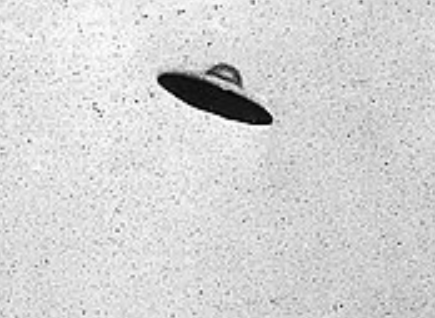
— Col. William T. Coleman, The Disbeliever / HuffPost accountAt closest approach, the B-25 came within roughly one eighth of a mile — approximately 660 feet — of the object. At that range, Coleman and his crew were able to observe it in significant physical detail. The object was disc-shaped, with a domed or thick cross-section, showing no rivet lines, portholes, windows, or external features of any kind. Its surface finish shifted with distance: highly reflective, almost mirror-like, when viewed at altitude — but at close range, the reflectivity vanished and the surface appeared as a non-reflective, uniform metallic material Coleman compared to a titanium finish.
As the object skimmed over the field at near-ground level, it generated two rotating vortexes of red dust — one on each side — described by Coleman as resembling a horizontal tornado. The disc's shadow was clearly visible on the field surface below it. Coleman executed a hard banking maneuver to attempt to cut off the object's flight path, ducking behind a tree line to emerge ahead of it. When he came back around, the object was gone, leaving only the settling dust vortexes behind in the field.
It was about 75 feet in diameter, 15-feet-thick at the center, no rivet lines, portholes, glass or windows. It was just metal — what I call a run-of-the-mill flying saucer. It wasn't reflective at all, except when it was at extreme altitude, it reflected sunlight, but as we got closer, all that disappeared. As it was going across the field, there were two vortexes coming off the edge of it as it went across that field. It was like a horizontal tornado.
— Col. William T. Coleman, HuffPost / National Atomic Testing Museum, 2012Approximately 45 minutes after the initial encounter over southern Alabama, Coleman and his crew were beginning their approach to Greenville, Mississippi — using the Meridian beacon to navigate through Greenwood — when Coleman spotted the object again. It appeared once more at the 2 o'clock high position, this time at high altitude, crossing the sky in the same relative bearing. The second observation was briefer than the first, but sufficiently clear for Coleman to make a positive identification as the same type of object.
Coleman made a deliberate command decision not to report the sighting while airborne. He did not want to initiate radio communications about the encounter in-flight — aware of the bureaucratic complications that would follow and the potential for interference with the landing procedure. Instead, he instructed his crew to say nothing until they were on the ground.
After landing, Coleman ordered each crew member — independently and without conferring — to write a detailed account of what they had witnessed and seal it in an envelope. The five sealed accounts were subsequently opened by a base intelligence officer, who noted that they were all remarkably similar. Coleman then formally filed a report with Project Blue Book through the appropriate military reporting chain.
The crew manifest for this mission comprised five individuals, each with technical or professional credentials that significantly raise the evidential weight of their combined testimony:
USAF bomber pilot, WWII veteran
USAF officer
USAF technical crew
Defense contractor
Defense contractor
Coleman filed a formal report with Project Blue Book through Air Force channels following the incident. Project Blue Book was the official U.S. Air Force UFO investigation program that ran from March 1952 to December 1969 under the auspices of the Air Technical Intelligence Center at Wright-Patterson Air Force Base, Ohio. The program reviewed over 12,618 reported sightings during its operational life, ultimately classifying 701 as "Unidentified" — the remainder attributed to conventional phenomena such as aircraft, weather balloons, astronomical objects, or psychological factors.
When Coleman later became the Air Force Public Information Officer for Project Blue Book — a position he held into the early 1960s — he requested a search of the Blue Book archive for his own 1955 report. The report could not be located. Coleman believed the CIA had obtained and withheld the report, removing it from the Blue Book files. Researcher Brad Sparks, who interviewed Coleman directly by telephone on July 11, 2002, suggested the case may simply have been misfiled or misdated — a known pattern in Blue Book record-keeping — but subsequent searches were unable to verify this or recover the document.
The irony of Coleman's position is significant: as Project Blue Book's Public Information Officer, he was the official Air Force voice on UFO matters — tasked with publicly defending the program's analytical conclusions and managing press relations on UFO reports — while privately holding an unresolved personal sighting experience that had disappeared from the very archive he represented. He found this situation professionally and personally troubling, and stated as much to researcher Brad Sparks during their 2002 telephone interview.
Researcher Brad Sparks conducted a telephone interview with Coleman lasting approximately 36 minutes (3:45–4:21 PM PDT), in which Coleman described the full sequence of events in detail. Sparks subsequently attempted on three further occasions — August 3, August 18, and October 13, 2002 — to obtain an exact date from Coleman's flight log, which Coleman confirmed was in his possession in a safe. Coleman was unable to retrieve it on each occasion, leaving the date officially logged only as "July 1955." The NICAP AVCAT database records the case under this designation with a credibility rating of 5 out of 5.
For years the sighting remained largely unknown outside the research community. In June 1978 — 23 years after the event — Coleman publicly disclosed the encounter for the first time on the Merv Griffin Show while promoting his NBC television series Project UFO, a dramatization of Blue Book cases that he co-produced with Jack Webb. The disclosure drew significant attention, though some commentators questioned the timing given the concurrent television promotion. Coleman addressed this skepticism directly over subsequent decades, maintaining the account's accuracy in multiple interviews and sworn contexts.
In 2020, Coleman's testimony was featured in director James Fox's documentary The Phenomenon, considered one of the most credible and rigorously produced UFO documentaries ever made. Fox described Coleman's account — nine minutes of active pursuit of a disc at treetop level, followed by a near-collision — as among the most compelling personal testimony he had collected across decades of investigation. Fox's team reportedly conducted a flight recreation, piloting the same B-25 model over the same area of Alabama to assess the plausibility of Coleman's described maneuvers.
No official Project Blue Book determination exists for this case, as the report submitted by Coleman was not found in the archive. The case therefore carries no formal Air Force classification. Given that 701 cases in the Blue Book archive were classified as "Unidentified" even with documentation on file, this case's absence from the record means it was never subjected to the Blue Book analytical process — an outcome that is itself anomalous for an incident involving a rated Air Force pilot and four corroborating witnesses.
The NICAP Aircraft Cases Index (AVCAT), compiled by researcher Fran Ridge in coordination with Dr. Richard Haines, assigns the Coleman case a credibility rating of 5 — the highest available — citing the qualifications of the primary witness, the corroborating multi-witness sealed testimony, and the absence of any conventional explanation for the described object behavior. Specific performance characteristics reported — instantaneous disappearance at maximum pursuit range, sustained low-altitude flight with distinctive aerodynamic ground effects, and the rapid altitude excursion from 20,000+ feet to near-ground level — remain unexplained by any known 1955-era or current aircraft technology.
Coleman himself resisted categorical conclusions throughout his life. He stated publicly on multiple occasions that he was "neither a skeptic nor a believer," preferring to describe exactly what he and his crew observed and leave interpretation to others. In 2012, at age 89, Coleman appeared as a panelist at the National Atomic Testing Museum's "Military UFO Files: Secrets Revealed" event alongside former Blue Book director Col. Robert Friend, Nick Pope, and other senior officials. He indicated he had a "blockbuster" revelation to share — then at the last moment chose not to disclose it. Museum executive director Allan Palmer, who witnessed the hesitation, stated he believed Coleman genuinely wanted to say something more but held back. Coleman died without making the intended disclosure public.
I think I've hit the nail on the head.
— Col. William T. Coleman, National Atomic Testing Museum, Las Vegas, 2012 — on the nature of UFOs, without elaboration- Q.01What happened to the original Blue Book report filed by Coleman? Was it deliberately removed — as Coleman believed, by the CIA — or was it a bureaucratic misfiling? No recovered document has ever matched this case.
- Q.02What was the "blockbuster" revelation Coleman declined to share at the 2012 National Atomic Testing Museum event? Museum director Allan Palmer believed he genuinely wanted to disclose something significant but stopped himself. It died with him.
- Q.03Can the exact flight date be established? Coleman confirmed his flight log was in his possession but was unable to retrieve it before his death, leaving only "July 1955" as the date. No Air Force flight records have surfaced to pin down the day.
- Q.04What do the sealed testimony envelopes say? Coleman stated they were opened by a base intelligence officer who confirmed their consistency — but the physical envelopes and their contents have never been publicly produced or located.
- Q.05What explains the two counter-rotating vortex trails? The "horizontal tornado" ground effect described by multiple crew members implies a propulsion or field effect of a type unknown to aerodynamics — yet no official investigation ever examined this specific characteristic.
- Q.06What were the identities of the Lockheed and General Motors engineers aboard, and have their accounts ever been collected? Coleman could not recall their names in 2002. These two civilian witnesses from major defense contractors have never come forward publicly.
- Q.07Why did the object reappear at Greenville, Mississippi, approximately 45 minutes after the Alabama encounter? Was the same object tracking the aircraft, or was this a separate and coincidental sighting?