In the early morning hours of February 25, 1942 — less than three months after the Japanese attack on Pearl Harbor — the city of Los Angeles and surrounding communities were placed on full military alert following detection of unidentified aerial objects over the region. At approximately 2:25 a.m., air raid sirens sounded across the metropolitan area, a total blackout was ordered, and anti-aircraft batteries of the U.S. Army's 37th Coast Artillery Brigade opened fire on objects tracked by searchlights over the city.
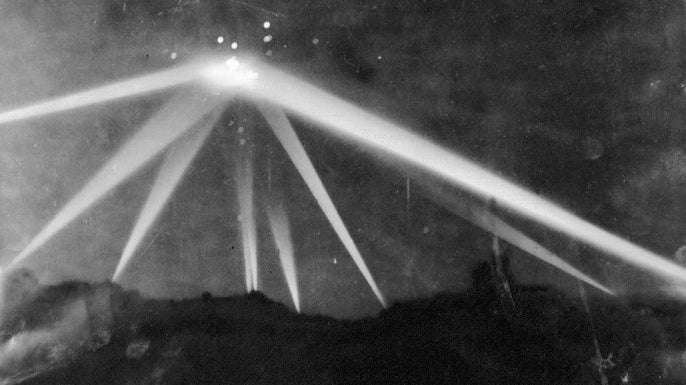
The anti-aircraft barrage was extraordinary in its scale. U.S. Army gun crews fired an estimated 1,430 rounds of ammunition over approximately one hour. The firing was concentrated over Santa Monica, Culver City, and Long Beach. Searchlight beams swept the sky while shell bursts illuminated objects that witnesses described as silvery, slow-moving, and arranged in V-shaped or chevron formations. The famous Los Angeles Times photograph from that night — showing searchlight beams converging on an apparent object above the city — became one of the most iconic images in UFO history.
Civilian witnesses across a wide geographic area reported seeing a large central object surrounded by smaller ones in formation. Multiple accounts described the objects as moving deliberately rather than drifting, and maintaining a fixed geometric relationship to one another over the course of the engagement. Police officers, civil defense workers, and ordinary residents filed reports that were collected by local authorities in the days that followed.
Despite the massive volume of anti-aircraft fire, no enemy aircraft were shot down, no bombs were dropped on the city, and no hostile aircraft wreckage was recovered anywhere in the Los Angeles basin. The incident resulted in five civilian deaths — three from traffic accidents caused by the blackout chaos and two from reported heart attacks — along with significant property damage from falling anti-aircraft shell fragments and unexploded rounds.
The incident occurred at a moment of extreme wartime tension: a Japanese submarine had shelled the Ellwood oil facility near Santa Barbara just two days earlier on February 23, and military and civilian personnel throughout Southern California were on high alert for a potential Japanese aerial assault on the coast. This charged context profoundly shaped both the initial military response and all subsequent official characterizations of the event.
Two official investigations were conducted in the immediate aftermath of the incident, and they reached diametrically opposite conclusions. The U.S. Army's Western Defense Command, led by General John DeWitt, maintained that real aircraft had been observed over Los Angeles and that the anti-aircraft response was fully justified. DeWitt's office suggested that between one and five aircraft had been detected operating over the city during the engagement period.
The U.S. Navy reached the opposite conclusion. Secretary of the Navy Frank Knox issued a statement characterizing the entire incident as a false alarm triggered by wartime anxiety. Knox's office suggested that no enemy aircraft had ever been present and that the anti-aircraft fire had been directed at weather balloons or atmospheric phenomena misidentified under the stress of a nighttime alert with searchlights already sweeping the sky. Secretary of War Henry Stimson later offered a third theory: that the objects were small private planes operated by enemy agents to deliberately trigger a false alarm and observe U.S. air defense response patterns. No evidence for Stimson's theory was ever produced.
The contradictory nature of these official statements — issued within 24 hours of the event by the Army and Navy — was remarkable and created public confusion that persisted for decades. Congressional inquiries attempted to reconcile the conflicting accounts but produced no definitive resolution. The disagreement between the services was never formally adjudicated, and no unified official account of the incident was ever published during the war.
In 1983, the Office of Air Force History reviewed the Battle of Los Angeles as part of a broader historical reassessment of wartime UFO incidents. The review concluded that the most plausible explanation was a combination of war nerves, misidentified weather balloons, and the psychological amplification of sightings once anti-aircraft guns opened fire and searchlights began sweeping the sky — a feedback loop in which each shell burst and searchlight crossing was interpreted as confirming the presence of enemy aircraft.
The famous Los Angeles Times photograph has been subjected to photographic analysis by multiple researchers over the decades. The image was produced using 1942 newspaper printing techniques that involved significant darkroom processing, contrast enhancement, and manual retouching to produce a print suitable for newsprint reproduction. Analysis of the original photographic negative — if it still exists and is accessible — has not been publicly conducted using modern densitometric or digital methods that could better characterize what was actually at the focal point of the searchlight beams.
No single authoritative official conclusion has ever been issued that fully satisfies the evidentiary record. The 1983 Air Force History review favored the false alarm hypothesis — war nerves, misidentified balloons, and collective panic amplified by the anti-aircraft response itself. This remains the closest thing to a current official position on the incident, but it has never been formally endorsed by all relevant agencies or presented as a definitive resolution.
The absence of recovered enemy aircraft wreckage, Japanese bomb damage, or any intercepted Japanese military communication referencing a Los Angeles air mission strongly argues that no Imperial Japanese aircraft were present over the city that night. However, these negatives do not explain what triggered the initial radar alert at 2:25 a.m. or what witnesses across a wide geographic area were observing before the anti-aircraft fire began and searchlights swept the sky.
The incident's historical credibility as a potential UAP encounter rests largely on two points: the extraordinary scale of the military response — 1,430 shells fired over one hour — which suggests that experienced military personnel genuinely believed they were engaging a real target, and the contradictory official explanations issued in the 24 hours after the event, which imply genuine institutional uncertainty rather than confident misidentification.
The Battle of Los Angeles predates the modern UFO era by five years and occurred in the context of an active war, making it difficult to evaluate using the methodological frameworks developed for the postwar UAP phenomenon. It nonetheless represents one of the largest and most consequential military engagements with an unidentified aerial object in American history and raises foundational questions about the pre-modern history of the UAP phenomenon that no subsequent investigation has definitively addressed.
- Q.01What triggered the initial radar alert at 2:25 a.m.? The Army's radar systems detected something that prompted the air raid alert before visual observations were widely reported. The nature and origin of that initial radar contact — whether an actual object, an atmospheric artifact, or equipment malfunction — has never been definitively characterized in any publicly available record from the investigation.
- Q.02Why did the Army and Navy issue contradictory official accounts within 24 hours? The immediate public contradiction between Army and Navy officials — one claiming real aircraft were present, the other calling it a complete false alarm — suggests genuine internal disagreement about what was actually detected that night. The classified communications and internal records that led to each service's position have never been fully released.
- Q.03What do unretouched original photographic negatives from that night actually show? The iconic Los Angeles Times photograph was heavily processed using 1942 printing techniques. Analysis of any surviving original negatives using modern digital methods could potentially reveal more about what, if anything, was present at the focal point of the searchlight beams — or confirm that the apparent object is entirely an artifact of the printing process.
- Q.04Were any physical fragments or debris consistent with an aerial object recovered from the engagement area? Despite 1,430 anti-aircraft rounds fired, no enemy aircraft debris was recovered. Whether investigators searched for and found any unusual fragments — from non-enemy aerial objects including balloons or otherwise — in the area below the engagement has not been documented in publicly available wartime records.
- Q.05Were all military witness reports from that night systematically collected and preserved? Military personnel, civil defense workers, and police officers who filed reports during and after the incident would have had their accounts documented in wartime military and civilian records. Whether these primary witness accounts have been fully declassified and made available to researchers remains an open archival question.
- Q.06Does the Battle of Los Angeles suggest the UAP phenomenon predates the modern post-1947 era? The incident occurred five years before Kenneth Arnold's 1947 sighting that launched the modern "flying saucer" era. As one of the most extensively documented mass military responses to anomalous aerial objects in pre-modern history, the case raises the possibility that the phenomenon now classified as UAP has a longer continuous record than the official post-1947 framework acknowledges — a question with significant implications for how researchers and institutions understand the origin and duration of the phenomenon.