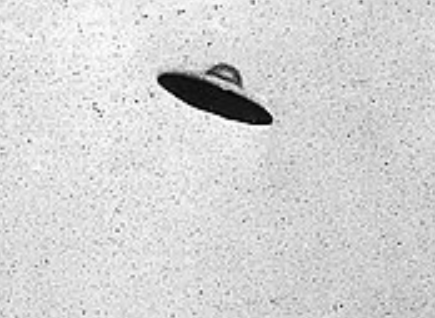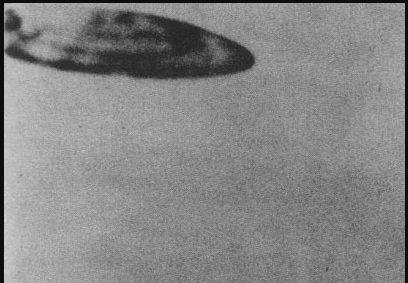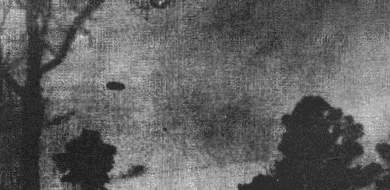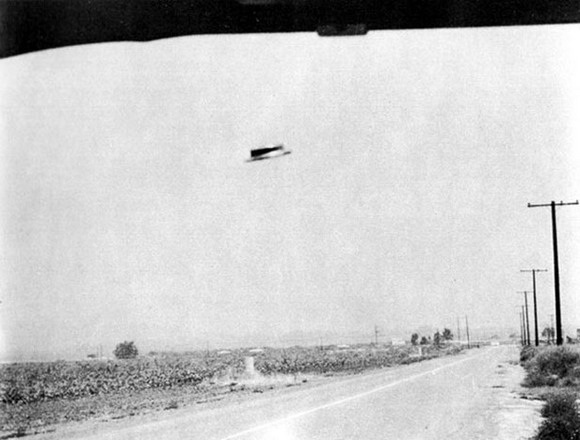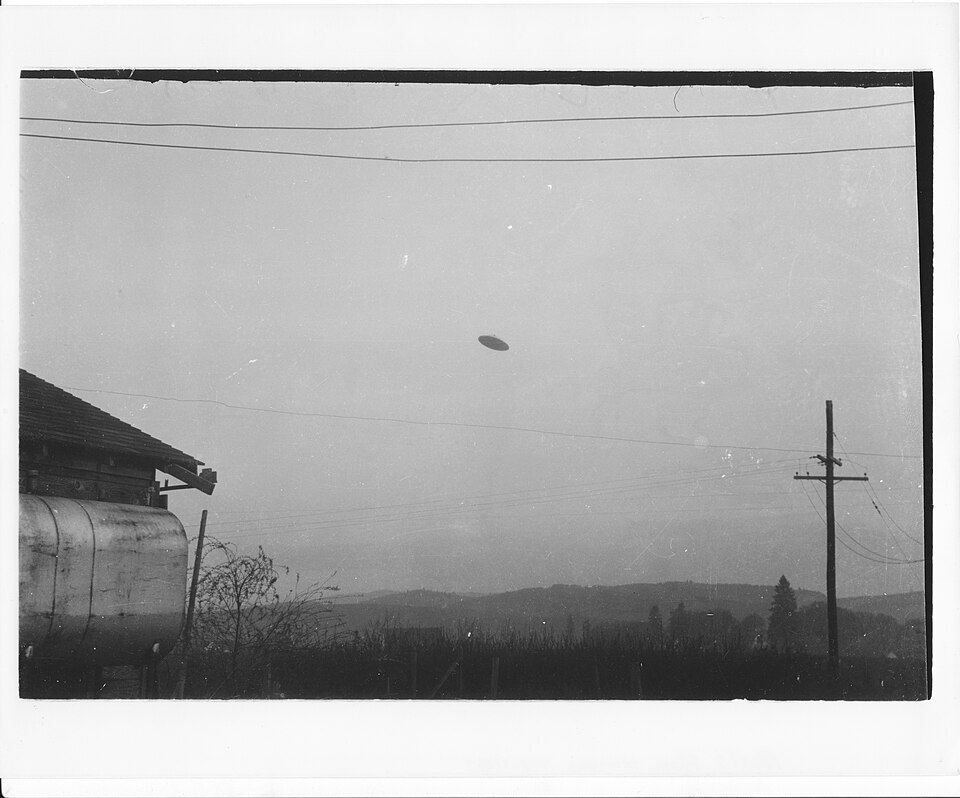
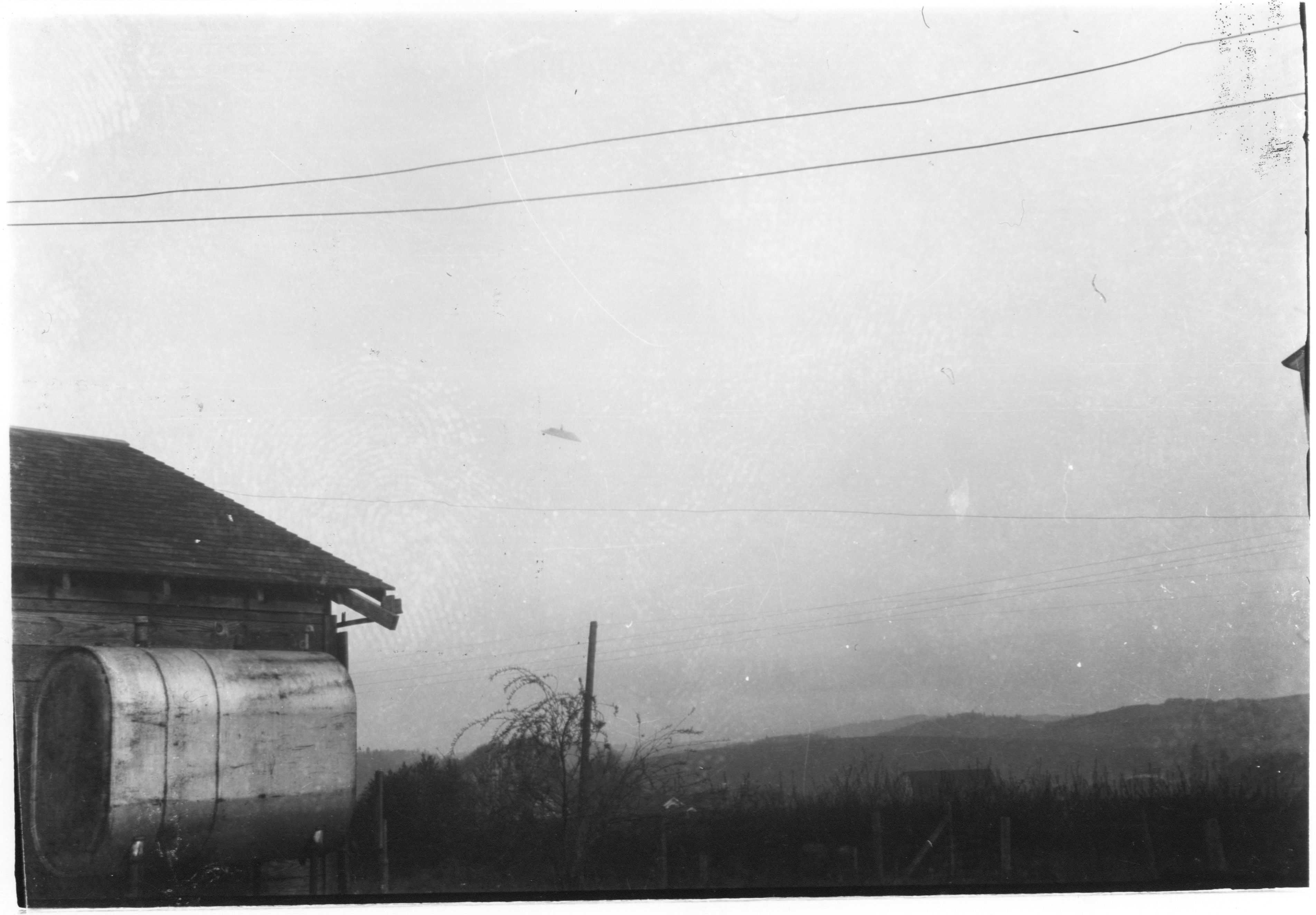
On the evening of May 11, 1950, Evelyn Trent was feeding rabbits at the family farm near McMinnville, Oregon when she spotted an unusual object in the sky to the northeast. She called to her husband Paul Trent, who was inside the farmhouse, and he came out and also observed the object. Paul retrieved the family camera, a Kodak Roamer loaded with film, and took two photographs of the object before it moved off to the west and out of sight. Both photographs were taken quickly, one after the other, before the object departed.
The photographs show a disc shaped object hanging in the air above the farm. The object has a flat underside and what appears to be a domed or superstructure component on its upper surface visible in profile. The sky in both photographs shows an overcast layer consistent with the weather conditions Evelyn Trent described. In both images the object is visible from roughly the same angle but at a slightly different position relative to the farmhouse roof and telephone wires in the foreground, consistent with the object having moved between the two exposures as Paul repositioned himself slightly.
The Trents were not eager publicity seekers. They completed the roll of film over the following weeks and did not initially have it developed. When the photographs were eventually processed, they showed the Trents' neighbors the images and word eventually reached the McMinnville Telephone Register newspaper, which published them in June 1950. The photographs were subsequently picked up by wire services and published nationally, including a prominent spread in Life Magazine. The Trents reported that they had no financial motivation for fabricating the images and received no meaningful compensation despite the international publication of the photographs.
The witnesses described the object as metallic in appearance, with a dull reflective surface, roughly the size of a large aircraft or somewhat smaller. It moved silently and they estimated it was traveling at a moderate speed before accelerating and departing to the west. Neither witness reported any unusual sounds, odors, or physical effects associated with the observation. The encounter was brief, lasting only the time required to retrieve the camera and take two exposures before the object moved beyond effective photograph range.
The Trent photographs entered the official UAP record when they were submitted to the U.S. Air Force and examined as part of Project Blue Book. They were subsequently subjected to multiple rounds of detailed photographic analysis across several decades, including a significant analysis as part of the University of Colorado UFO Project commissioned by the Air Force in the 1960s and commonly known as the Condon Report. They remain among the most technically studied photographs in the entire UAP record and one of the very few for which multiple independent professional photographic analyses have reached generally consistent conclusions about their authenticity.
Project Blue Book examined the Trent photographs and interviewed the witnesses. The program's investigators found no evidence of hoax in either the witness interviews or the photographic analysis, but assigned the case the designation of unknown rather than identified, declining to offer a conventional explanation. The witnesses were assessed as sincere and the photographs as apparently genuine, but no positive identification of the object was produced from the Blue Book investigation.
The most significant official photographic analysis of the Trent photographs was conducted by Dr. William K. Hartmann for the University of Colorado UFO Project, published as part of the Condon Report in 1969. Hartmann examined the original negatives and applied photometric analysis to study the object's brightness, shadowing, and apparent reflectivity relative to the surrounding sky conditions. His conclusion was that the photographs appeared to be genuine and that the photometric evidence was inconsistent with a nearby small model hanging from the telephone wire or farmhouse structure. He assessed the object as appearing to be at a distance consistent with a large craft at altitude rather than a small model at close range.
Hartmann's analysis was the most technically rigorous examination of the photographs conducted up to that point and remains one of the foundational technical assessments in the case record. His conclusion favoring authenticity was significant given that the Condon Report's overall approach to UAP was highly skeptical and that many cases included in the report received more dismissive treatments. The McMinnville photographs' survival of the Condon Report's scrutiny with an essentially favorable conclusion from the project's own analyst gives them unusual standing among pre-1970 UAP photographs.
Skeptical investigators including Robert Sheaffer conducted subsequent analyses arguing that the shadowing on the object in the photographs is inconsistent with the lighting conditions described by the Trents and that the object's apparent brightness pattern suggests a small model lit from below rather than a large object in open air. Sheaffer's analysis proposed that the photographs were taken in the evening rather than at the time the Trents indicated, based on shadow direction analysis. This interpretation has been disputed by other analysts who reach different conclusions from the same photometric data.
The most recent significant technical analyses were conducted using digital scanning of the original negatives and computer modeling of the photometric and shadow data. These analyses have not produced a consensus resolution of the authenticity question, with different investigators applying different assumptions about lighting geometry and arriving at different conclusions. The case thus joins a small group of historical UAP photographs for which modern digital analysis has been applied but has not settled the fundamental question of authenticity.
Project Blue Book's official conclusion was unidentified. The Condon Report's analysis by Dr. Hartmann was the most favorable official photographic assessment any pre-1970 UAP photograph received, finding the photometric evidence consistent with a genuine large object at distance and inconsistent with the most obvious hoax mechanism. No official investigation has produced a confirmed alternative explanation that satisfies the photometric data from the photographs.
The McMinnville photographs occupy a unique position in the historical UAP photograph archive. They are among the very few photographs from the classic era of UFO sightings that survived rigorous professional photographic analysis without being either convincingly debunked or explained by a conventional identification. Their survival of both Blue Book scrutiny and the Condon Report's analysis, combined with the witnesses' apparent lack of commercial motivation and consistent story over many years, makes them the benchmark against which other historical UFO photographs are often measured.
The ongoing disagreement between analysts who find the photometric evidence favorable to authenticity and those who argue for a small model is a genuine scientific dispute that has not been resolved by any definitive analysis. This stalemate reflects the fundamental challenge of conclusively authenticating historical photographs using only the images themselves: without independent physical evidence of the photographed object, photographic analysis can constrain but generally cannot definitively determine whether an unusual object in a photograph is real or fabricated.
The McMinnville case has transcended the specific evidentiary question to become a cultural touchstone. The annual McMinnville UFO Festival held each May in the city that bears the photographs' name has grown into one of the largest UAP themed events in the world. Whatever the ultimate status of the photographs, they represent a permanent and culturally significant chapter in the American encounter with the possibility of anomalous aerial phenomena and in the history of how communities relate to unexplained events in their own backyards.
- Q.01Where are the original negative plates, and can they be subjected to modern high resolution scanning and analysis? Hartmann's analysis in the Condon Report was conducted on the original negatives in 1967. The current location and condition of those negatives, whether they have been preserved in archival conditions, and whether they are available for reanalysis using current digital densitometry and computational photogrammetry techniques has not been publicly established in recent accounts of the case.
- Q.02Can the shadow direction controversy be definitively resolved? Sheaffer and other skeptics argue the shadow direction on the object indicates evening illumination inconsistent with the witnesses' stated time of observation. Hartmann and others dispute this reading. Whether a definitive three dimensional computational model of the lighting geometry at the Trent farm on May 11, 1950 using surveyable geographic reference points and known solar ephemeris data could resolve this dispute has not been established in the published analysis record.
- Q.03What is the object's apparent size as constrained by the photographic geometry? Using the known dimensions of the telephone wires and farmhouse structures visible in the photographs as scaling references, combined with the object's angular size in the frame, a range of possible object sizes at different distances can be calculated. Whether such a calculation has been performed rigorously with surveyed reference dimensions and published with full methodology has not been established in accessible accounts of the photographic analysis history.
- Q.04Did any other observers in the McMinnville area report unusual aerial objects on or around May 11, 1950? UFO waves in the early 1950s frequently involved multiple independent reports from a geographic area over a short period. Whether any other witnesses in Yamhill County Oregon reported anomalous aerial objects in the spring of 1950, and whether those reports were collected and investigated by Blue Book or local authorities, has not been established in publicly available accounts of the case's investigation history.
- Q.05What did the Trents report about the object's motion and behavior that is not captured in the photographs? The two photographs represent a fraction of a second of the total encounter. The Trents observed the object for a longer period before Paul retrieved the camera, and the object continued to move after the photographs were taken. What they observed about the object's flight path, apparent altitude changes, and departure behavior in the time not captured by the photographs has not been comprehensively documented in any published account of the case.
- Q.06What methodological lessons does the McMinnville case offer for evaluating historical UAP photographs in the current era? The Trent photographs have been analyzed by multiple teams of investigators over more than seventy years, with persistent disagreement about the most basic factual question of whether the images are authentic. This outcome illustrates both the irreplaceable value of high quality photographic evidence in UAP cases and the fundamental limitation of photographic analysis as a tool for definitive authentication without independent physical evidence. As modern UAP investigation increasingly relies on sensor data rather than photographs, the McMinnville case remains a valuable reference for understanding what photographic evidence can and cannot establish, and what additional data streams are necessary to make photographic UAP evidence scientifically conclusive.