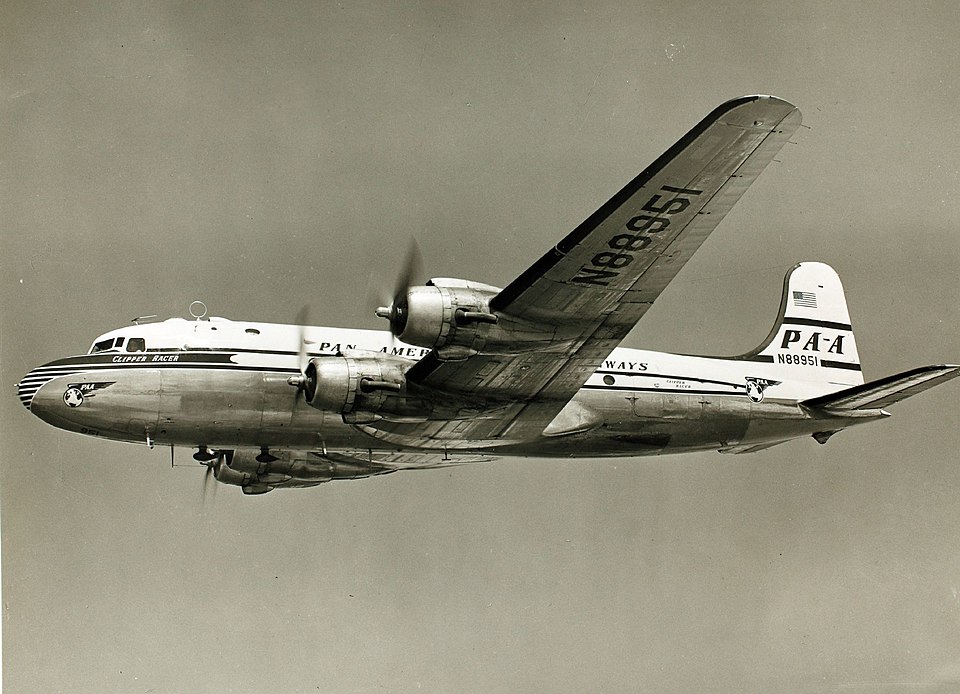
On the evening of July 14, 1952, a Pan American World Airways Douglas DC-4 was on a routine scheduled passenger flight southbound from New York to Miami. The aircraft carried ten passengers and a crew of three. At the controls were Captain F.V. Koepke, First Officer William B. Nash — a Navy veteran who had flown patrol bombers during World War II — and Second Officer William H. Fortenberry, who had served two years in the U.S. Navy's experimental air wing. Both Nash and Fortenberry had received intensive military training in aircraft and vessel identification. The sun had set approximately one hour earlier. Skies were clear with unlimited visibility.
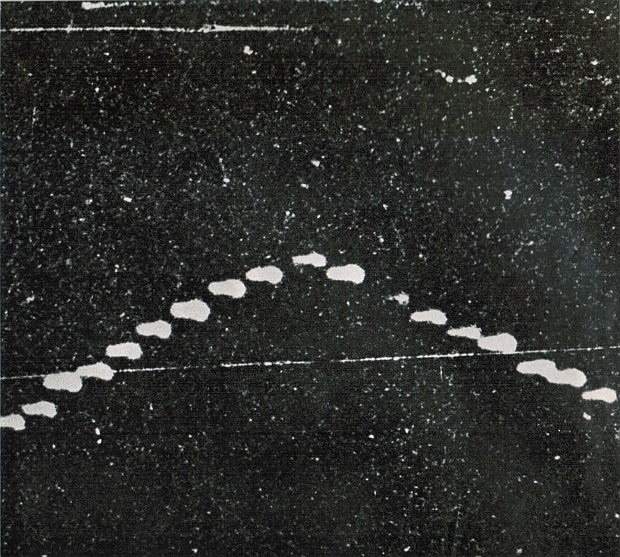
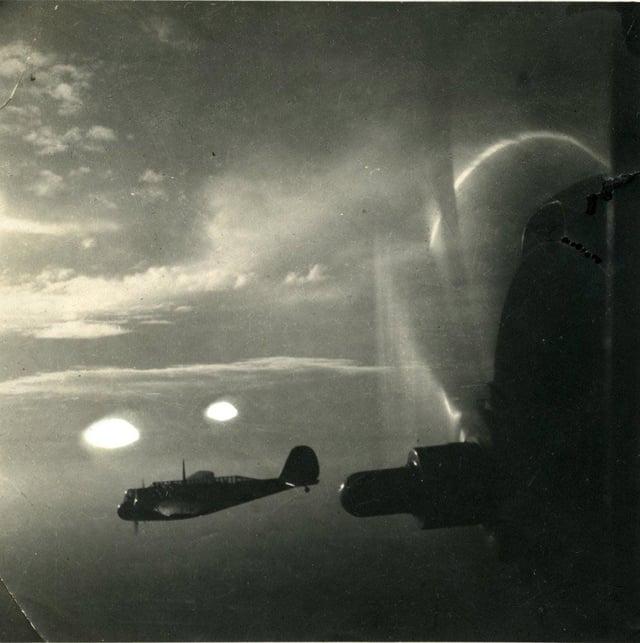
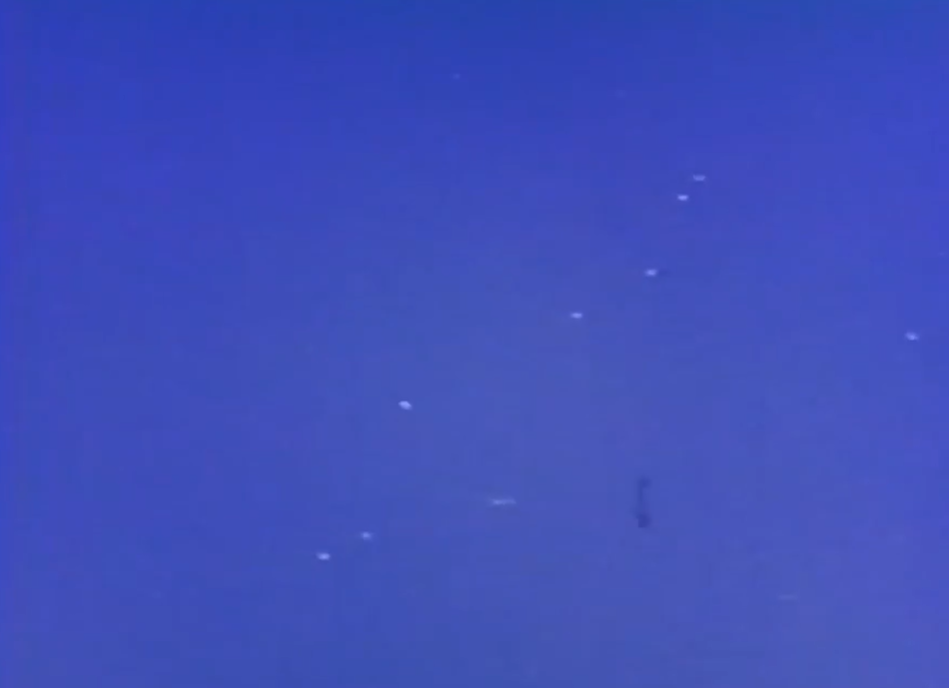
At approximately 8:12 p.m. Eastern Daylight Time, the aircraft was cruising southbound at 8,000 feet on autopilot over the Chesapeake Bay, approaching Norfolk, Virginia. Nash was orienting Fortenberry — on his first run over this route — by pointing out landmarks below. He had just identified the glow of Newport News and the city of Cumberland to the right when a vivid red-orange brilliance flared near the ground level ahead and slightly to the right. Within seconds, both pilots recognized the source: six discrete objects, circular in shape, approaching at low altitude and extraordinary speed directly below and toward their aircraft.
Their shape was clearly outlined and evidently circular. The edges were well-defined, not phosphorescent or fuzzy in any way, but sharp and clearly delineated. They were holding a narrow echelon formation — a stepped-up line tilted slightly to our right, with the leader at the lowest point and each following craft slightly higher.
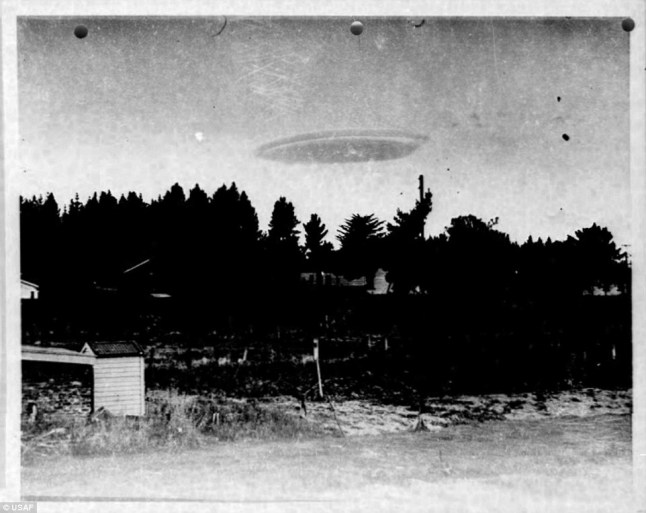
— 1st Officer William B. Nash, TRUE Magazine, October 1952The six objects were in a tight, stepped echelon formation — each disc slightly higher than the one ahead of it — and were streaking toward and beneath the DC-4 at an altitude Nash and Fortenberry later estimated at approximately 2,000 feet, roughly one mile below the aircraft. They had the character of glowing coals at intense heat but with considerably greater luminosity, and their disc profile was unmistakable: circular, with clearly defined edges, each estimated at approximately 100 feet in diameter and 15 feet in thickness.
As the objects approached and passed beneath the DC-4, the lead disc abruptly decelerated — so sharply that the second and third objects nearly overran it. The entire formation then executed a maneuver that both pilots would describe in consistent, precise detail: all six discs simultaneously flipped on edge, rotating so that the glowing top surface faced right and the unlighted edge faced upward and left. In this edgewise orientation they were revealed to be flat on top with the appearance of coins viewed from the side. Then — still edgewise — the last five objects slid forward past the leader, reversing the echelon so the formation was now tail-foremost. The entire reversal took only a fraction of a second.
All together, they flipped on edge, the sides to the left going up and the glowing surface facing right. Though the bottom surfaces did not become clearly visible, we had the impression that they were unlighted. The exposed edges, also unlighted, appeared to be about 15 feet thick, and the top surface, at least, seemed flat. In shape and proportion, they were much like coins. While all were in the edgewise position, the last five slid over and past the leader so that the echelon was now tail-foremost, so to speak, the top or last craft now being nearest to our position.
— Nash & Fortenberry, joint account · NICAP / TRUE Magazine, 1952After completing the formation reversal, the discs flipped back to the flat, glowing position and accelerated away to the west at a sharp angle to their original heading. As they did, Nash and Fortenberry observed two additional objects rising from below — the same type, same color, same disc profile — ascending rapidly to join the formation. All eight objects then climbed steeply together and vanished. The entire sequence — from first observation to disappearance — lasted approximately 15 seconds. Nash immediately radioed a report to be forwarded to the Air Force through the Norfolk facility.
To contextualize the speed: using navigational charts and landmarks to measure the distance covered against the elapsed time, Nash and Fortenberry computed the objects' velocity at approximately 12,000 miles per hour. The SR-71 Blackbird — the fastest jet aircraft ever built, not yet in service in 1952 — has a top speed of approximately 2,200 mph. The objects were traveling at roughly five and a half times that speed while executing tight formation reversals.
Nash and Fortenberry were the only two cockpit crew members who witnessed the event. Captain Koepke was not at the controls and did not observe the objects. No passengers reported seeing anything, as the objects passed beneath and slightly to the right — only visible through the cockpit windscreen from the pilot and co-pilot positions. The credibility of Nash and Fortenberry as observers is strongly supported by their combined military aviation backgrounds:
During the OSI investigation the morning after the sighting, Nash was informed by Air Force investigators that seven independent reports had already been received, all describing the same type of object over the same area. Among the corroborating witnesses:
Naval officer, USS Roanoke cruiser — Wrote to the Norfolk Virginian-Pilot after press coverage appeared. Reported sighting eight red lights near Point Comfort proceeding in a straight line before disappearing. His observation was at approximately 8:55 p.m. EDT — roughly 15 minutes before Nash and Fortenberry's sighting.
Norfolk civilian woman — Reported to press that she and a friend, seated in Stockley Gardens, observed flying saucers circling overhead and heading north. She described seven or eight objects, the first three white and the others yellow and red.
Paul R. Hill, NASA Langley aerodynamicist — Inspired by press coverage of Nash/Fortenberry, Hill went to watch the sky on July 16 near the waterfront. He observed four amber-colored objects approach from the south and maneuver overhead. Hill, a professional aerodynamicist, went on to conduct a rigorous private technical analysis of UFO reports over the following decades. His work was published posthumously as Unconventional Flying Objects: A Scientific Analysis — one of the most technically serious studies of the phenomenon ever produced.
Nash and Fortenberry landed at Miami International Airport shortly after midnight. They found that their in-flight radio transmission had already been received and processed — but with a telling modification. The operations office had a copy of their message to the military via Norfolk with an addendum: "Advise crew five jets were in area at the time." Nash and Fortenberry immediately identified two problems with this response: the objects numbered eight, not five, and they were absolutely certain — given the performance characteristics, the disc profile, the coordinated formation behavior, and the observed edgewise rotation — that what they had seen were not jets.
At 7:00 a.m. the following morning, Air Force investigators telephoned Nash and set an interview for later that day. Major John H. Sharpe — Wing Intelligence Officer — and four additional officers from the 7th District Office of Special Investigations arrived at Miami Airport. Nash and Fortenberry were separated and questioned independently for one hour and forty-five minutes each, after which they were jointly debriefed. Their accounts were found to be consistent in all material respects.
Nash later recalled: "The investigators advised us that they already had seven other reports. One was from a lieutenant commander and his wife. They described a formation of red discs traveling at high speed and making immediate direction changes without turn radius." The phrase "without turn radius" is technically significant — it means the objects changed direction instantaneously, without the curved arc that any aircraft or missile, subject to inertia and aerodynamic forces, must execute when changing course.
The case was submitted to Project Blue Book at Wright-Patterson Air Force Base, Ohio — the official U.S. Air Force UFO investigation program then operating under the Air Technical Intelligence Center. Blue Book analysts reviewed the case and were unable to assign a conventional explanation. The Nash-Fortenberry sighting was formally classified as Unknown in the Project Blue Book archive — placing it among the 701 cases out of 12,618 that the program's own investigators could not explain.
The case was filed less than a week before the July 19–20 and July 26–27, 1952 Washington D.C. radar incidents — the most publicly significant UFO events of the decade — when multiple radar installations simultaneously tracked unknown targets over restricted airspace above the U.S. Capitol. Project Blue Book was receiving approximately twenty reports per day by mid-July 1952. The unexplained rate was running near 40 percent. The Nash-Fortenberry report arrived at Wright-Patterson at the center of what became known as the "Big Flap" of 1952 — the largest single-summer concentration of UFO reports in the history of the Air Force program.
Nash subsequently published a first-person account of the encounter in TRUE Magazine in October 1952 — one of the most widely circulated American magazines of the era — as well as a follow-up in TRUE's 1967 special UFO issue. He also provided a detailed account to the National Investigations Committee on Aerial Phenomena (NICAP), and was interviewed on the record by researchers Thomas Tulien and Jan Aldrich on January 4, 2002, as part of the Sign Oral History Project.
Project Blue Book's official determination — Unknown — represents the program's concession that no conventional explanation could be assigned to this case. The Air Force's own attempt to close the report with the "five jets" addendum on the night of the sighting was contradicted by Nash and Fortenberry on multiple specific grounds, and the subsequent OSI investigation did not produce any alternative identification.
The most prominent counter-explanation came from Harvard astronomer Dr. Donald Howard Menzel in his 1963 book The World of Flying Saucers. Menzel proposed two hypotheses: first, that the pilots had seen lights on the ground distorted by atmospheric haze; second, that they had seen fireflies trapped between the two panes of glass in the cockpit window. Nash addressed both publicly. The "haze" hypothesis is incompatible with the pilots' independently consistent description of the objects — including precise diameter estimates, thickness, edge definition, color uniformity, formation geometry, and the edgewise rotation — none of which could be reproduced by ground light distortion. The "firefly" hypothesis requires accepting that two experienced military-trained Navy veterans and commercial airline officers, independently and consistently, mistook insects inside their cockpit for objects performing coordinated formation maneuvers at 12,000 mph across 50 kilometers of observed sky.
There is no doubt in our minds that we saw missiles of some kind operating under intelligent control.
— 1st Officer William B. Nash, Associated Press, July 1952The case remains notable in the research literature for the precision of the pilot observations. Because Nash was familiar with the geography below — having just identified Newport News and Cumberland — the objects' positions could be correlated against known landmarks to derive speed and range with considerably more confidence than in most sightings. UFO researcher and physicist Stanton Friedman described the Nash-Fortenberry case as among a small number of incidents where the observational data is sufficiently precise to make meaningful aerodynamic inferences about the objects' performance.
Two days after Nash and Fortenberry's sighting, NASA Langley aerodynamicist Paul R. Hill observed four similar amber-colored objects from the waterfront in the same general area. Hill spent the subsequent decades conducting a rigorous technical study of UFO performance characteristics, concluding in his posthumously published analysis that the objects demonstrated consistent and explicable physics — but physics radically beyond any 1952-era or known human technology.
- Q.01What were the two additional objects observed ascending from below during the encounter — and where had they been prior to joining the formation of six?
- Q.02The objects executed a formation reversal while edgewise, then re-formed and accelerated to ~12,000 mph without any visible deceleration arc. What physical mechanism allows an object of ~100 ft diameter and apparent mass to reverse direction and achieve that speed instantaneously?
- Q.03Air Force investigators told Nash they already had seven independent reports before his debrief. What do those seven reports say, and are they all in the declassified Blue Book archive?
- Q.04The naval officer from USS Roanoke observed eight red lights in the same area approximately 15 minutes before Nash and Fortenberry's sighting. Were these the same objects — and if so, what were they doing in that 15-minute interval?
- Q.05Why did the Air Force's initial response attempt to explain the sighting with "five jets" — a number and type that contradicted the pilots' report on every material point — and who authorized that message?
- Q.06The edgewise rotation that revealed the disc profile and the formation slide maneuver were described identically by Nash and Fortenberry in separate interrogations. What does that level of independent consistency imply about the precision of the observation?
- Q.07This incident occurred one week before the July 19–20 Washington D.C. radar events. Were the objects tracked by radar on those dates related to what Nash and Fortenberry observed over Chesapeake Bay?