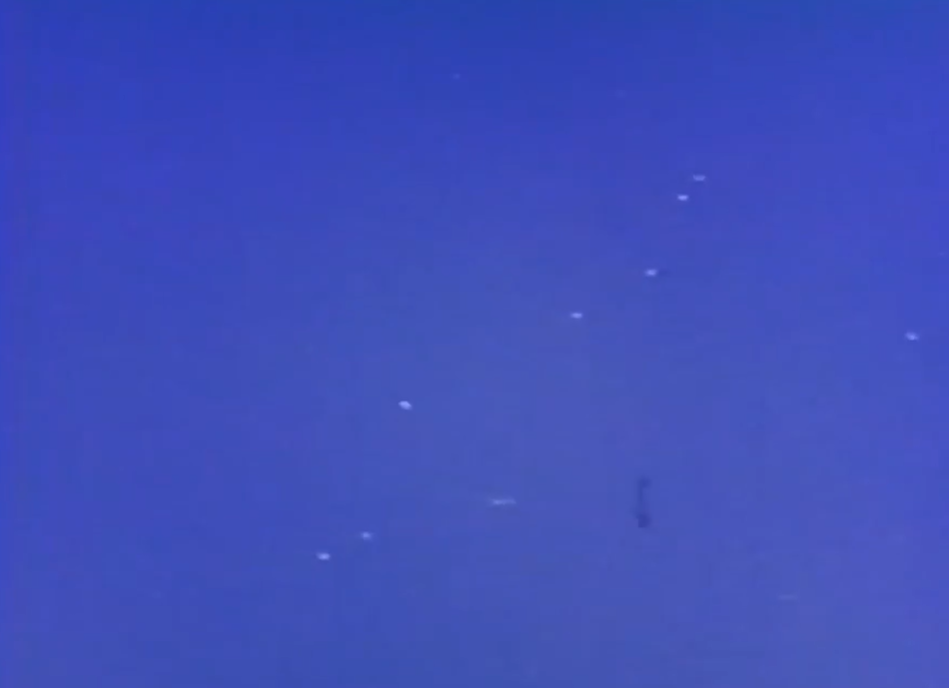
On the morning of July 2, 1952, Navy Warrant Officer Delbert C. Newhouse was driving with his wife and two children along U.S. Highway 30 near Tremonton, Utah when his wife first noticed a group of unusual objects in the sky above the horizon. Newhouse stopped the vehicle and observed the objects. He estimated there were approximately 12 to 14 objects milling and maneuvering in a loose formation at what he initially assessed as high altitude. Newhouse was an experienced Navy photographer with approximately 1,100 hours of aerial photography experience, making him one of the most technically qualified civilian witnesses of any early UAP encounter to have also captured visual evidence.
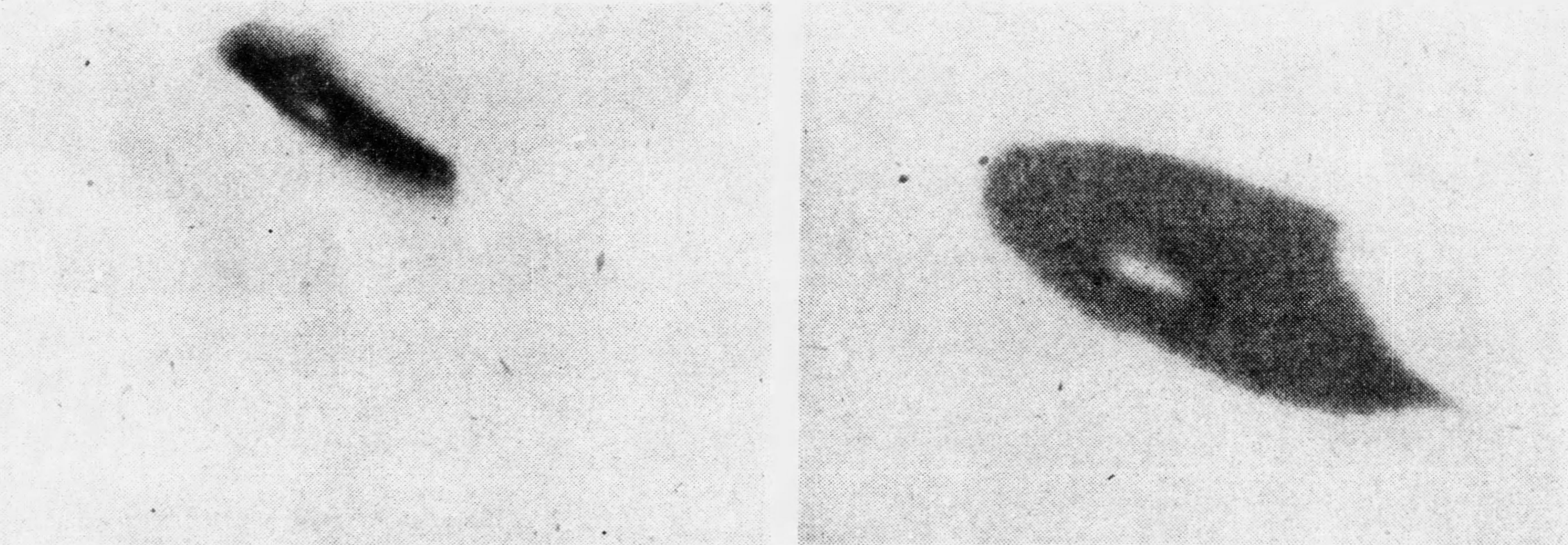
Newhouse retrieved his Bell and Howell 16mm movie camera and 103mm telephoto lens from the car and began filming. He captured approximately 75 feet of 16mm color film showing the objects moving across the sky. In the film, the objects appear as bright, roughly circular forms moving individually and collectively, breaking from the main group and returning, changing direction, and maneuvering in ways that Newhouse and subsequent analysts found inconsistent with a rigid formation of conventional aircraft flying in coordinated flight. One object separates from the group and moves in the opposite direction of the others at one point in the footage.
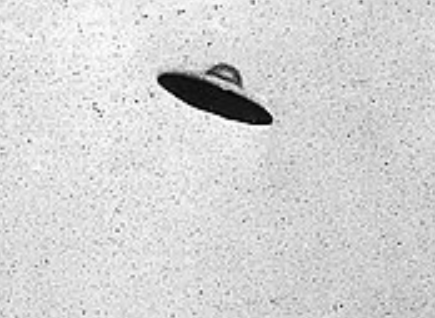
Newhouse described the objects as shaped like two saucers placed face to face, giving them a biconvex or lens shape that he could discern when one of the objects was visible at a closer range before he retrieved his camera. By the time he had the camera ready, the objects had moved to a greater distance and the individual shapes were less discernible, appearing primarily as bright discs in the film. This detail is important: Newhouse's description of the objects' shape at closer range, before filming began, is not captured in the footage but is part of the witness record he provided to investigators.
The Newhouse film was immediately significant because of his professional qualifications. A career Navy photographer with extensive aerial motion picture experience was not someone who could be easily characterized as an inexperienced observer prone to misidentifying birds, aircraft, or atmospheric phenomena. Investigators who interviewed Newhouse consistently described him as a precise, technically sophisticated witness whose account was measured and consistent. His military background and professional photographic expertise gave the film a provenance and credibility that most civilian UAP films of the era entirely lacked.
Newhouse submitted the film to the Air Force through official channels. It was subsequently analyzed by the Navy's Photo Reconnaissance Laboratory at Anacostia and by Air Force investigators working on Project Blue Book. The film became one of the most analyzed pieces of motion picture evidence in the early UFO era and was a central exhibit in the Robertson Panel convened by the CIA in January 1953 to review the best available UAP evidence then in government hands.
The Navy Photo Reconnaissance Laboratory at Anacostia conducted the most technically rigorous early analysis of the Tremonton film. Navy analysts examined the film frame by frame and performed photometric measurements of the objects' brightness relative to calibrated light sources photographed with the same equipment under known conditions. Their conclusion was that the objects were self luminous rather than reflecting sunlight, that their brightness was approximately five times that of the sky background at the time of filming, and that the footage was inconsistent with any known natural or artificial aerial phenomenon. The Navy lab's analysis assessed the objects as genuine anomalous aerial phenomena of unknown origin.
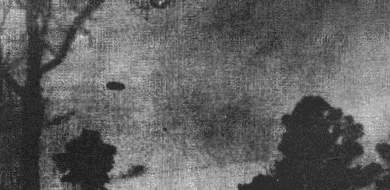
The Robertson Panel, convened by the CIA in January 1953 and chaired by physicist H.P. Robertson, reviewed both the Tremonton film and the Great Falls film as its two primary pieces of motion picture evidence. The panel included five prominent scientists and reviewed the Tremonton footage over several sessions. The panel's scientists viewed the Navy lab's analysis more skeptically and proposed that the objects could be birds, specifically seagulls, reflecting sunlight. The panel recommended that the film be further analyzed to test the bird hypothesis, and this recommendation influenced subsequent Air Force handling of the case.
Project Blue Book subsequently subjected the film to additional analysis and ultimately accepted the bird hypothesis as the most plausible conventional explanation. This conclusion was disputed immediately and persistently by Newhouse, who stated emphatically that birds were not what he had observed and that he had seen birds on the same day and was entirely capable of distinguishing them from what he filmed. Blue Book investigators noted that Newhouse himself had identified the objects as unlike any bird he had seen, but the program proceeded with the bird explanation as its official disposition.
The Robertson Panel's handling of the Tremonton film is historically significant beyond the specific case. The panel's recommendations went beyond simply explaining individual sightings and suggested a public education program to debunk UFO reports and reduce public interest in the phenomenon. This policy recommendation, which shaped Air Force and CIA handling of UAP evidence for the following decade, was motivated partly by national security concerns about the possibility that Soviet adversaries could exploit public interest in UFOs to create confusion in American air defense systems. The Tremonton film's encounter with the Robertson Panel thus illustrates how Cold War security concerns shaped the official treatment of even high quality UAP evidence.
Independent analysis of the Tremonton film by researchers including Dr. Robert M.L. Baker Jr. of Douglas Aircraft Company used optical equipment to measure the angular accelerations of the individual objects. Baker's 1956 analysis concluded that the objects' measured angular accelerations were inconsistent with birds or balloons and were instead consistent with objects performing maneuvering flight at speeds far exceeding any known aircraft. His findings were presented to a congressional subcommittee in 1968 and represent one of the most technically detailed independent analyses of any early UAP film.
Project Blue Book's official conclusion was that the Tremonton film showed birds, most likely seagulls reflecting sunlight. This conclusion was based substantially on the Robertson Panel's suggestion and was disputed by the Navy's own photographic laboratory, whose more technically rigorous analysis had reached a different conclusion. The disagreement between the Navy lab's assessment and Blue Book's final disposition was never officially resolved and represented one of the more transparent instances of the program reaching a conclusion inconsistent with its own analytical evidence.
Newhouse's consistent rejection of the bird explanation is particularly significant given his professional qualifications. A Navy photographer with over 1,100 hours of aerial photography experience, who described seeing birds on the same day as the filming and who observed the objects at close enough range before filming to describe their biconvex shape, is not a witness whose identification of the objects as unlike birds can be easily dismissed. His professional assessment has been taken seriously by researchers across the ideological spectrum of UAP analysis.
The Tremonton film represents a case where the gap between the most thorough internal government analysis and the official conclusion is unusually stark and documented. The Navy lab's conclusion that the objects were self luminous anomalous phenomena was replaced in the official record by the bird explanation without any publicly available refutation of the lab's specific photometric findings. This institutional outcome has been cited repeatedly as evidence that Project Blue Book's primary function was not genuine scientific investigation but rather the production of conventional explanations regardless of the evidence quality.
The Tremonton film alongside the Great Falls film remains among the most technically analyzed pieces of UAP motion picture evidence from the early UFO era, and the Baker angular acceleration analysis remains one of the most technically specific quantitative arguments for anomalous performance in any historical UAP case. The film's significance is durable regardless of the official disposition precisely because the quality of the analysis it received was substantially higher than what most UAP evidence of its era ever generated.
- Q.01What were the specific photometric findings of the Navy Photo Reconnaissance Laboratory, and how were they formally addressed in Blue Book's acceptance of the bird hypothesis? The Navy lab's conclusion that the objects were self luminous rather than reflective represents a fundamental physical incompatibility with the bird explanation. How Blue Book's analysts reconciled the lab's specific brightness measurements with the bird hypothesis has not been established in any publicly available document from the program's files.
- Q.02Does Baker's angular acceleration analysis survive modern reexamination with digital analysis tools? Baker's 1956 conclusion that the objects' angular accelerations were inconsistent with birds was performed using optical equipment available in the mid 1950s. Whether his measurements and methodology have been reproduced or refuted using modern digital frame analysis and photogrammetric tools applied to a high quality scan of the original film has not been established in recent published accounts of the case.
- Q.03Where is the original 16mm film, and can it be digitally scanned at high resolution for reanalysis? The original Newhouse film would produce far richer analytical data when scanned at high resolution than the generation copies used in most historical analyses. Whether the film is preserved in Air Force archives, the National Archives, or some other repository, and whether it is accessible for modern digitization and analysis, is an open question with significant consequences for the case's evidential status.
- Q.04What did the Robertson Panel's classified deliberations reveal about how the CIA and Air Force actually assessed the Tremonton film internally? The Robertson Panel's declassified report describes its conclusions but may not fully represent the internal assessments of the panel members during deliberations. Whether additional classified memoranda or records from the panel's sessions contain more candid assessments of the Tremonton film's evidential weight has not been established through the available FOIA record of the CIA's UAP related archives.
- Q.05What did Newhouse describe about the objects' appearance before he began filming? Newhouse consistently reported that he could see the objects' biconvex shape clearly when they were at closer range before he retrieved his camera, and that this shape was clearly not that of birds. Whether any investigators formally documented this pre film observation in enough technical detail to allow independent assessment of what specific object shape and size he was actually describing at that closer range has not been established in publicly available accounts of the investigation.
- Q.06What does the Robertson Panel's influence on the Tremonton case reveal about the politicization of UAP evidence assessment during the Cold War era? The panel's recommendation to pursue public debunking of UAP reports, partly implemented through Blue Book's subsequent handling of cases like Tremonton, represents a documented instance of national security policy considerations overriding evidence based scientific analysis in the treatment of a specific piece of high quality UAP evidence. Understanding how this dynamic shaped the official UAP evidence record from 1953 through Blue Book's closure in 1969 is essential context for evaluating the completeness and reliability of that record as a foundation for current AARO investigations, and for assessing how much genuine anomalous evidence may have been institutionally suppressed rather than genuinely explained during those sixteen years.