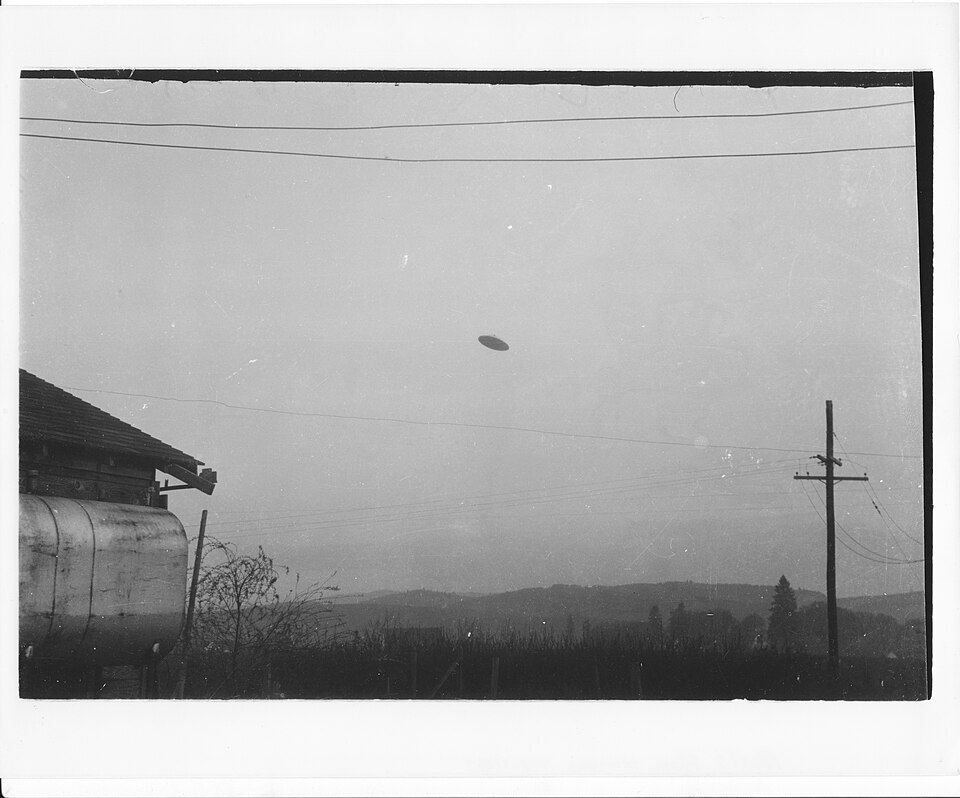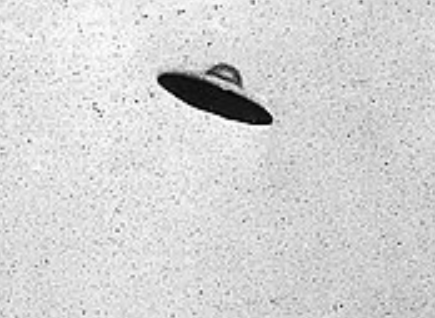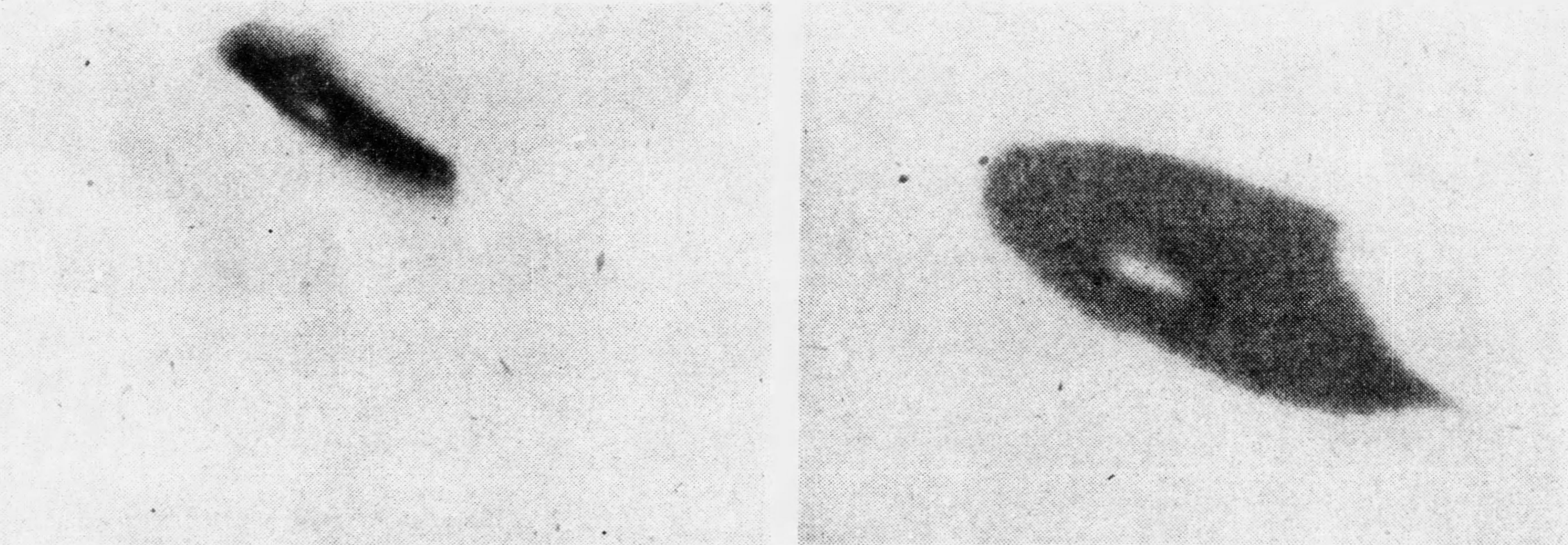
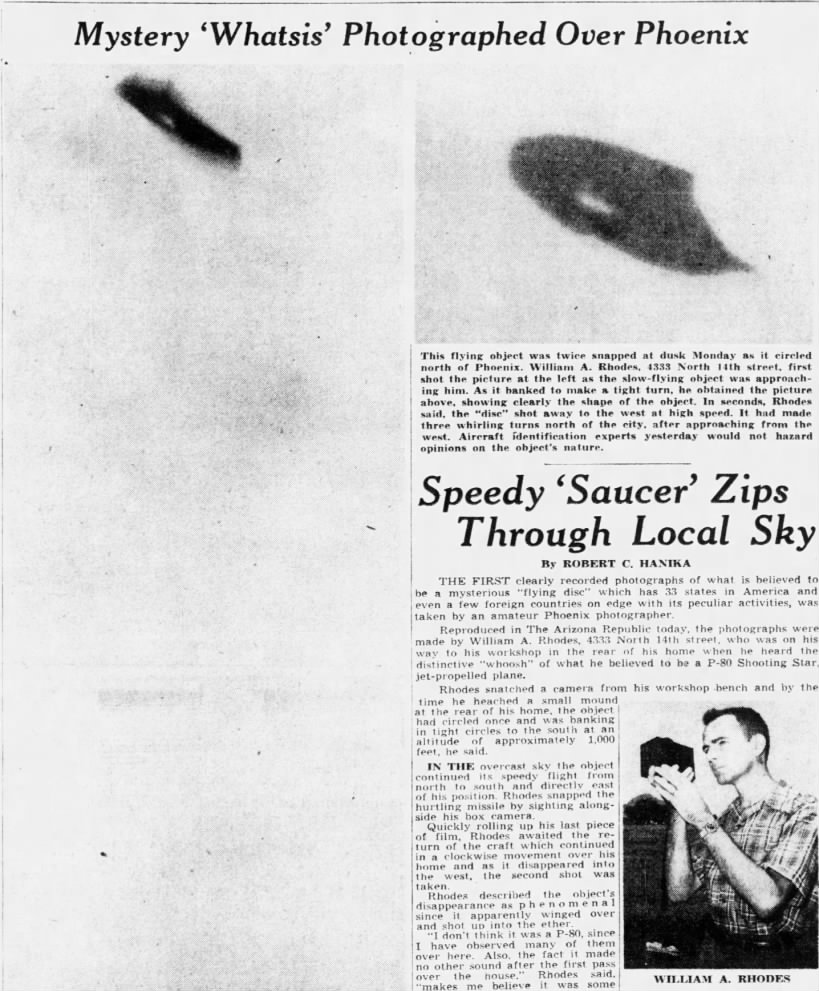
On July 7, 1947, William A. Rhodes, an amateur astronomer and model airplane manufacturer, photographed a disc-like object flying over Phoenix, Arizona. Rhodes was walking to his home workshop when he heard a loud "whoosh" which he believed came from a jet-propelled Lockheed P-80 Shooting Star. He grabbed his camera and took two photographs of the mysterious object.
The photographs, published in The Arizona Republic on July 9, 1947, showed what Rhodes described as "the shape of a heel of a shoe, with a small hole in the center." The object was described as making three passes over his home and leaving two trails of vapor. After the initial "whoosh," the object was completely silent.
These photographs were among the first showing an unidentified flying object to be published, occurring near the height of the 1947 flying disc craze that began after Kenneth Arnold's famous sighting on June 24, 1947.
The photographs drew immediate attention from authorities. On July 8, 1947, the FBI obtained copies of the photographs from the managing editor of The Arizona Republic. On August 29, 1947, Rhodes was interviewed by Special Agent Brower of the FBI and George Fugate Jr. of the Army's Counterintelligence Corps at Hamilton Field. Rhodes provided them with both photographs and negatives.
Two Air Materiel Command officers also visited Rhodes in Phoenix to investigate. The Air Force's first secret UFO study, published in 1949 and titled Analysis of Flying Object Incidents in the United States, included the Rhodes photographs. Project Blue Book designated the case as "Incident 40."
Files released in 2015 detailed the official investigation. Investigators also discovered that Rhodes had written a letter to Amazing Stories magazine asking for advice on suing the government to get back his photographs and negatives—though he had never made such a request to any government agency.
The Air Force consulted four "expert photographers" about the Rhodes photographs. They "disagreed with each other as to the possibility of filming such an occurrence under the conditions described." The Air Force noted that Rhodes referred to himself as chief of staff of a laboratory with photography specialties, yet "the negative was carelessly cut and faultily developed. It is covered with streaks and over a period of six months, has faded very noticeably."
Dr. Irving Langmuir studied the photographs and, after learning of the prior passage of a thunderstorm, concluded the photographed object was merely paper swept up by the winds. The Air Force concluded that the object was likely windblown debris—a piece of paper or other lightweight material caught in the storm winds.
Some researchers have suggested the photographs may have been a hoax, noting the similarity between Rhodes's object and descriptions of a purported Soviet "atomic-powered" flying craft that was reported in the same day's newspapers.
- Q.01What exactly did Rhodes photograph? While officially attributed to windblown debris, the exact nature of the object remains disputed among UFO researchers.
- Q.02Was Rhodes a credible witness? His claim to be "chief of staff" of a photography laboratory and his letter to Amazing Stories suggesting he wanted to profit from the photographs raise questions about his motives.
- Q.03Did Rhodes hoax the photographs? The similarity to the alleged Soviet craft described in newspapers on the same day has led some to suggest he may have created the images to capitalize on the flying disc craze.
- Q.04What happened to the original negatives and prints? Reports of government seizure of materials have never been fully verified.