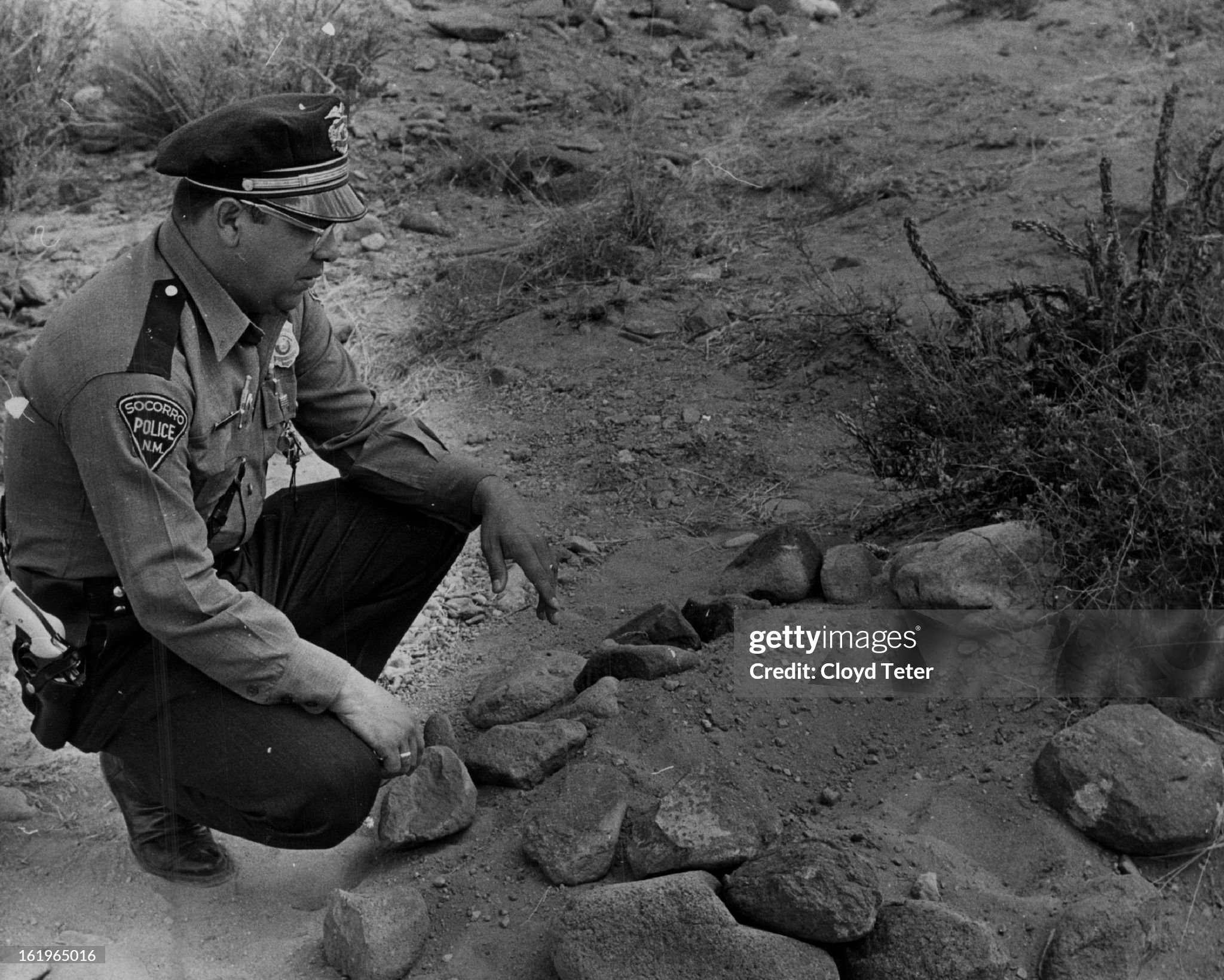
On the afternoon of April 24, 1964, Socorro, New Mexico police officer Lonnie Zamora was in pursuit of a speeding vehicle on the outskirts of town when he heard a loud roar and saw a blue and orange flame descending toward the desert southwest of the highway. Concerned that a dynamite shack in that area might have exploded, Zamora broke off the chase and drove toward the flame. He was a veteran officer with an established reputation for reliability, having served with the Socorro Police Department for several years without incident. What he encountered in the arroyos south of town became the most thoroughly investigated and most credible close encounter landing case in Project Blue Book's entire history.
Zamora drove his patrol car over rough terrain toward where he had seen the flame descend. Cresting a rise, he first observed at a distance what he initially took to be an overturned white car in the arroyo below, with two figures in white coveralls standing beside it. As he drove closer to assist with what he assumed was a traffic accident, the figures appeared to notice his approach. The object itself, as he came closer, was clearly not a conventional vehicle: it was smooth, white or metallic, egg shaped, and resting on four angular landing legs extending from its underside. It bore a single red insignia on its surface that Zamora later reproduced in his official report.
As Zamora stopped his car and got out to approach, the object produced a loud roar and emitted the blue and orange flame he had seen from the highway. Startled, Zamora retreated behind his car and shielded his eyes. When the roaring ceased, he looked up and observed the object rising silently from the arroyo, now with no visible flame, and departing rapidly to the southwest at low altitude before climbing and disappearing from view. The entire close observation lasted approximately two to three minutes. Zamora was visibly shaken when Sergeant M.S. Chavez, who had received his radio call and arrived at the scene minutes after the object's departure, found him standing beside his patrol car in the arroyo.
The physical evidence at the site was extensive and immediately documented. Four depressions in the hard caliche soil corresponded precisely to the position and spacing of the landing legs Zamora had described, pressed approximately two inches into the ground. Burned vegetation was found at the point below where the flame had appeared, with the burning pattern consistent with a heat source directed downward from a stationary position. Burned cardboard and other materials within the burn zone were consistent with a brief, intense heat event. Soil samples were collected from both the depression marks and the burn zone for laboratory analysis.
Project Blue Book dispatched investigators to Socorro within 24 hours of the incident. Dr. J. Allen Hynek, the program's scientific consultant, later stated publicly that the Socorro case was the single most impressive and inexplicable in Blue Book's files, and that Zamora's credibility as a witness was beyond question. Army Major William Connor from the White Sands Missile Range, located approximately 25 miles from Socorro, visited the site and confirmed the physical evidence. The Socorro incident quickly became the gold standard against which Blue Book measured all subsequent landing trace cases, and it retains that status in the historical record today.
Project Blue Book's investigation of the Socorro case was more thorough than almost any other case in the program's history. Investigators arrived quickly, the site was preserved in essentially its original condition, multiple soil samples were collected from the depression marks and burn area, and Zamora was interviewed extensively by both Blue Book investigators and by Dr. Hynek personally. Sergeant Chavez provided corroborating testimony confirming Zamora's shaken state and the physical evidence he had observed upon arrival at the scene. The Socorro police chief and the local FBI agent both confirmed the credibility of Zamora's account and the genuineness of the physical evidence.
The physical trace evidence received laboratory analysis that produced ambiguous results. Soil samples from the depression marks showed no unusual elemental composition distinguishing them from surrounding soil, and the burned vegetation samples were consistent with ordinary combustion rather than any exotic energy source. The absence of anomalous residue was cited by skeptics as evidence against an extraordinary event, though the absence of unusual chemical residue is equally consistent with a highly engineered craft that produces a clean combustion exhaust rather than an exotic energy source leaving identifiable byproducts.
The alternative explanations considered by Blue Book investigators included an experimental aircraft from White Sands or Holloman Air Force Base, a Lunar Landing Research Vehicle prototype, a hoax, and various natural phenomena. The hoax hypothesis was thoroughly investigated and found implausible: the depressions in the hard caliche required a substantial weight to produce them, the burn pattern was inconsistent with any accelerant application, and Zamora's emotional state as described by the first officer to reach him was genuine rather than performed. No one with motive or capability to stage such an elaborate physical trace event in that location was ever identified.
The experimental aircraft hypothesis received the most serious official attention. White Sands Missile Range and Holloman Air Force Base were both within range of Socorro and operated various classified test vehicles. Blue Book investigators made inquiries about programs that might account for the described craft and were told that nothing operational at either facility matched the description. Dr. Hynek made the same inquiries and received the same negative response. Whether a comprehensive review of all classified programs at both facilities was actually conducted, or whether the response reflected only information voluntarily offered by those facilities, has never been independently verified.
Blue Book's final assessment, delivered by Dr. Hynek, was that the Socorro case remained unexplained and that it represented genuine physical evidence of an anomalous landed object. This conclusion was unusual for Blue Book, which typically forced cases into conventional categories even when the evidence was ambiguous. Hynek's willingness to designate Socorro as genuinely unknown reflected the case's exceptional evidential quality and his own growing disillusionment with the program's systematic approach to assigning conventional explanations regardless of evidence quality.
Project Blue Book designated the Socorro case as unknown, one of the very few landing trace cases to receive this designation in the program's history. Dr. Hynek's formal assessment that Zamora was a credible witness and the physical evidence was genuine has never been officially retracted or superseded by any subsequent government investigation. The case remains officially unexplained in the government record after more than sixty years.
The Socorro case is distinguished from most UAP sightings by the combination of a single highly credible witness with no apparent motive for fabrication, extensive physical trace evidence that was documented before it could be altered, independent corroboration from a second officer who arrived at the scene while physical evidence was still fresh, and rapid and thorough official investigation that found no conventional explanation. These elements together make it one of the most internally consistent and evidentially robust landing trace cases in the global record.
The insignia that Zamora described and sketched on the object's surface represents one of the case's most distinctive and underexplored features. Zamora reported a red symbol that he reproduced carefully in his official report. Whether this symbol corresponds to any known military or civilian aircraft identification marking, any known symbol system, or any marking reported in other UAP cases has been explored by researchers but never resolved. Blue Book investigators reportedly requested that Zamora alter his public description of the symbol to prevent potential copycat hoaxes, a decision that introduced a minor inconsistency between his early public accounts and his official report.
The Socorro landing stands as the defining case for what UAP researchers call the close encounter of the second kind category, encounters involving physical trace evidence left by an unknown object. Its combination of witness quality, physical evidence, rapid official investigation, and official designation as unknown makes it the benchmark against which all subsequent landing trace cases are measured. In the current era of AARO investigations, Socorro represents the type of case whose physical evidence would most benefit from modern forensic analysis techniques unavailable in 1964.
- Q.01Are the original soil and vegetation samples from the Socorro site preserved in any accessible archive and could they be subjected to modern analytical methods? The soil samples collected in 1964 were analyzed with the techniques available at that time. Whether these samples were preserved in Air Force or government archives and whether they are accessible for reanalysis using modern methods including isotopic analysis, mass spectrometry, or other techniques unavailable in 1964 has not been publicly established.
- Q.02What did the two figures Zamora observed near the object look like in more detail and why has this element received relatively little attention? Zamora reported two figures in white coveralls standing near the object before it departed. His descriptions of their apparent size and posture have been recorded but not extensively analyzed in most public accounts of the case. Whether the figures were occupants of the craft, their apparent physical characteristics, and what they did when Zamora approached are details that could bear significantly on interpretations of what he encountered.
- Q.03What was the insignia on the craft's surface, and why did Blue Book request that Zamora alter his public description of it? Zamora sketched the symbol carefully in his official report. Blue Book investigators reportedly asked him to describe a different symbol publicly to prevent hoaxes. What the actual symbol was, whether it matches any known marking system, and what Blue Book's reasoning was for the unusual step of asking a witness to misrepresent evidence in public accounts of his own experience has not been fully addressed in available declassified program records.
- Q.04Were there other witnesses to the object's approach or departure who were not reached by Blue Book investigators? Socorro was a small town in 1964 but not unpopulated. The object's departure trajectory took it across terrain visible from the highway and surrounding area. Whether any other individuals observed unusual aerial activity in the Socorro area on the afternoon of April 24, 1964 and whether they were systematically canvassed by investigators is not established in publicly available Blue Book records from the case.
- Q.05Were all classified programs at White Sands and Holloman fully reviewed in the investigation, or only those voluntarily disclosed by those facilities? Blue Book investigators received negative responses to their inquiries about experimental aircraft at nearby test facilities. Whether a comprehensive independent review of all classified flight programs was conducted, or whether the negative response reflected only information those facilities chose to volunteer, has never been independently verified. The proximity of the world's most advanced aerospace test range to the incident site makes this question particularly consequential.
- Q.06What does the Socorro case reveal about the value of physical trace evidence in UAP investigation and its absence from the modern evidence record? Socorro remains the most thoroughly documented physical trace landing case in official UAP history precisely because a trained observer happened to encounter the site while evidence was fresh and because official investigators arrived quickly. The current era of UAP investigation is dominated by sensor footage rather than physical evidence, raising the question of whether physical trace encounters continue to occur but go undocumented because reporting mechanisms and response protocols are inadequate, or whether the phenomenon itself has changed its character. AARO's investigative protocols and whether they include provisions for rapid forensic response to physical trace reports is a question with direct implications for whether cases of Socorro's evidential quality could be properly documented if they occur today.